

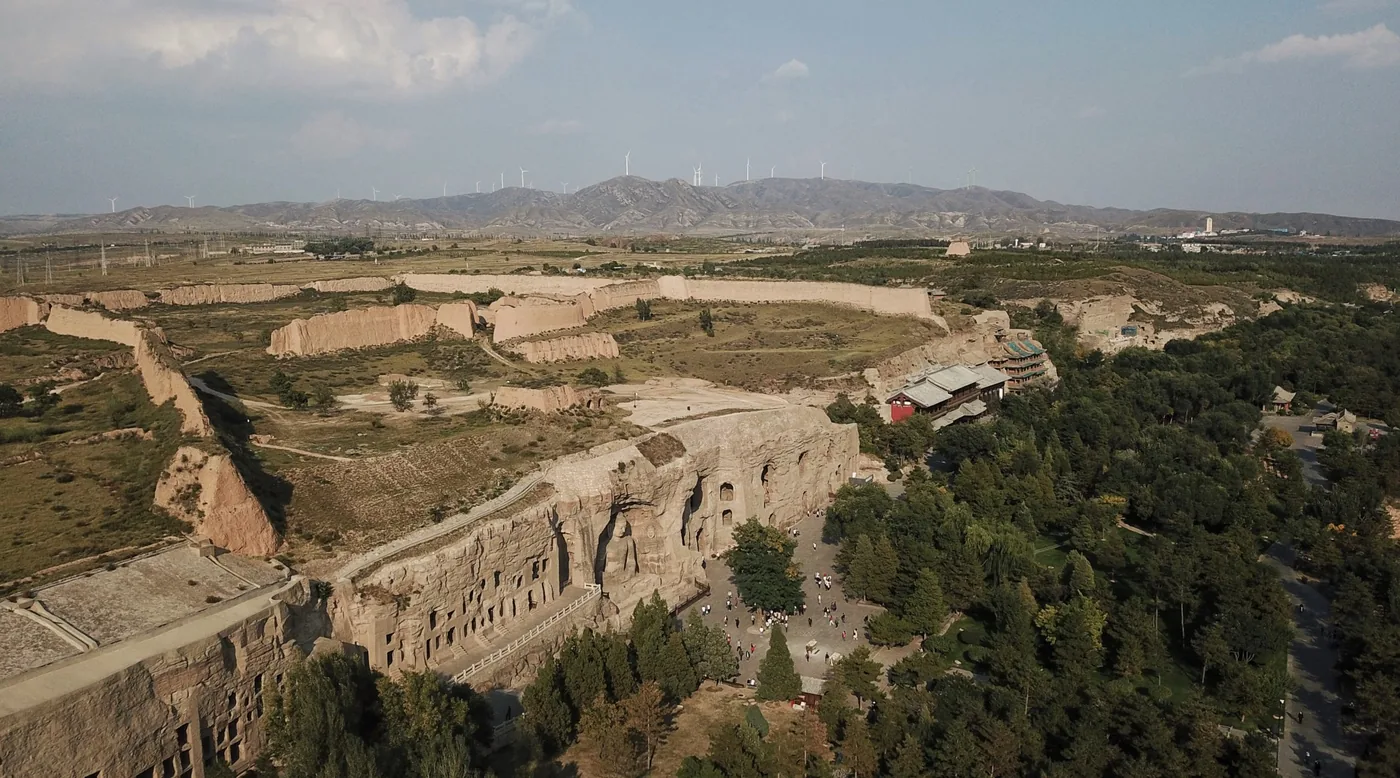
Most visitors land in Datong [dah-TONG] (大同, the northern Shanxi city where Buddhist cave art, frontier defense, and coal country have overlapped for fifteen centuries) and assume they have started with the appetizer. They have not. They have started with the thesis. Shanxi [shahn-SHEE] (山西, the north China province west of Beijing where cave Buddhas, timber pagodas, merchant cities, and Yellow River force still survive inside one readable landscape) can look scattered on a map. Datong sits up north. Pingyao Ancient City and Taiyuan [tie-YWEN] (太原, Shanxi’s capital, the political and transport anchor of the central basin) pull the eye inward. Hukou Waterfall feels like another story entirely. If you browse the names one by one, Shanxi risks looking like a bag of unrelated highlights. Once you actually move through it in sequence, that impression falls apart.
That is the real trick with Shanxi: it makes more sense as a route than as a checklist. The province is not strongest when each stop has to explain itself alone. It is strongest when one place prepares your eye for the next. A cave complex changes how you read a pagoda. A cliff temple makes a frontier pass feel necessary instead of decorative. A spring-fed shrine becomes the quiet preface to a merchant city. By the time the Yellow River arrives, Shanxi is no longer a series of names. It is a structure.
Shanxi Reads Better as a Route Than as a Checklist
Some destinations reward free assembly. You can pick a famous palace, add a photogenic street, maybe throw in a museum, and still come away with a coherent sense of place. Shanxi is less generous in that way. Its strongest sites belong to different historical systems: Northern Wei Buddhist carving, Liao and Song timber building, frontier defense, Qing merchant finance, fortress settlement, and Yellow River geography. If you cherry-pick only the two or three most famous stops, the province can feel overly academic or oddly fragmented.
What helps is progression. Shanxi becomes much easier to understand when the route moves from sacred image-making to structural timber confidence, then to edge conditions and military pressure, then to ritual and commercial order, and finally to the rougher survival logic of river and fortification. In other words, the order is not just transport planning. It is interpretation.
Yungang Grottoes and Yingxian Wooden Pagoda Build Shanxi’s First Logic
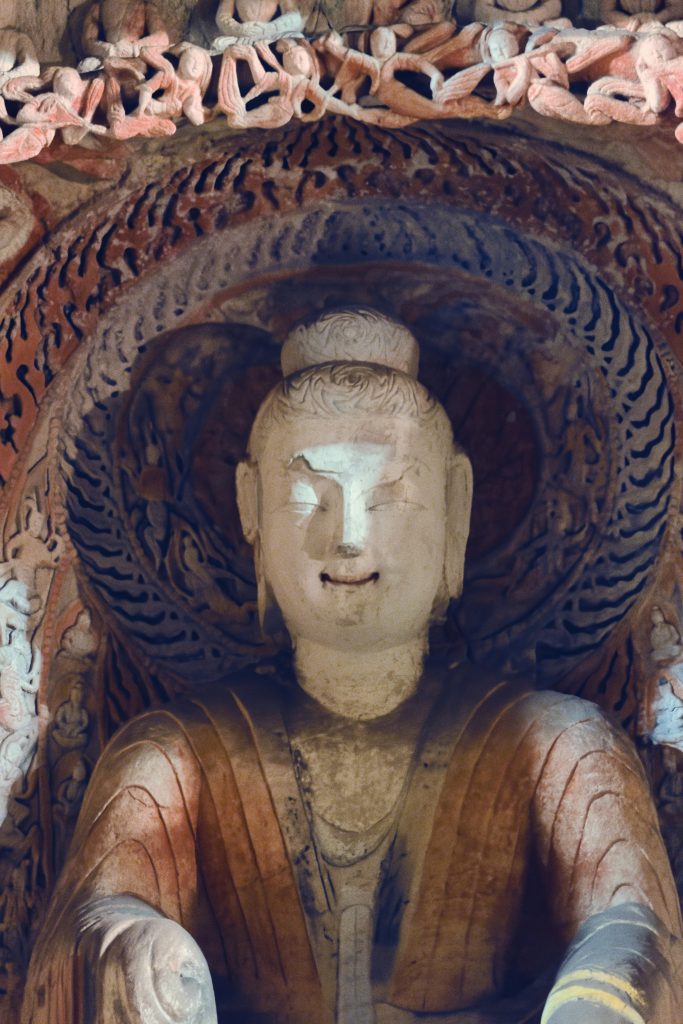
Yungang Grottoes [YOON-gahng] (云冈石窟, the Datong cave complex with more than 50,000 Buddhist figures carved into the sandstone under Northern Wei patronage) is an excellent place to begin because it establishes scale, belief, and northern visual seriousness all at once. You are not easing into Shanxi with something merely picturesque. You are beginning with a site where political ambition, Buddhist image-making, and rock-cut craft all become visible together. At Cave 20, the seated Buddha rises nearly fourteen meters from ochre-toned sandstone that seems to glow warmer the longer you look; dust hangs in the afternoon light between the cliff face and the open sky, and the sheer volume of carved detail — thousands of smaller figures flanking the central colossus — makes the air feel heavier with intention. It gives the province weight immediately.
Then Yingxian Wooden Pagoda [YING-shyen] (应县木塔, the 1056 all-timber tower that still stands as the tallest fully wooden pagoda in China) changes the conversation from carved image to built structure. That shift matters. After Yungang Grottoes, you already understand that Shanxi can hold religious intensity. The pagoda at Yingxian shows that it can also hold astonishing technical confidence in wood. Stand at the base and look up through the bracket systems — the interlocking timber arms spiral upward in repeating geometries, each layer solving a structural problem the one below handed it, and the whole thing creaks faintly in wind like a living instrument. One stop gives you carved permanence in stone; the next gives you vertical risk and structural intelligence in timber. Together they establish the province’s first sentence.
Hanging Temple and Yanmen Pass Add the Edge and the Pressure
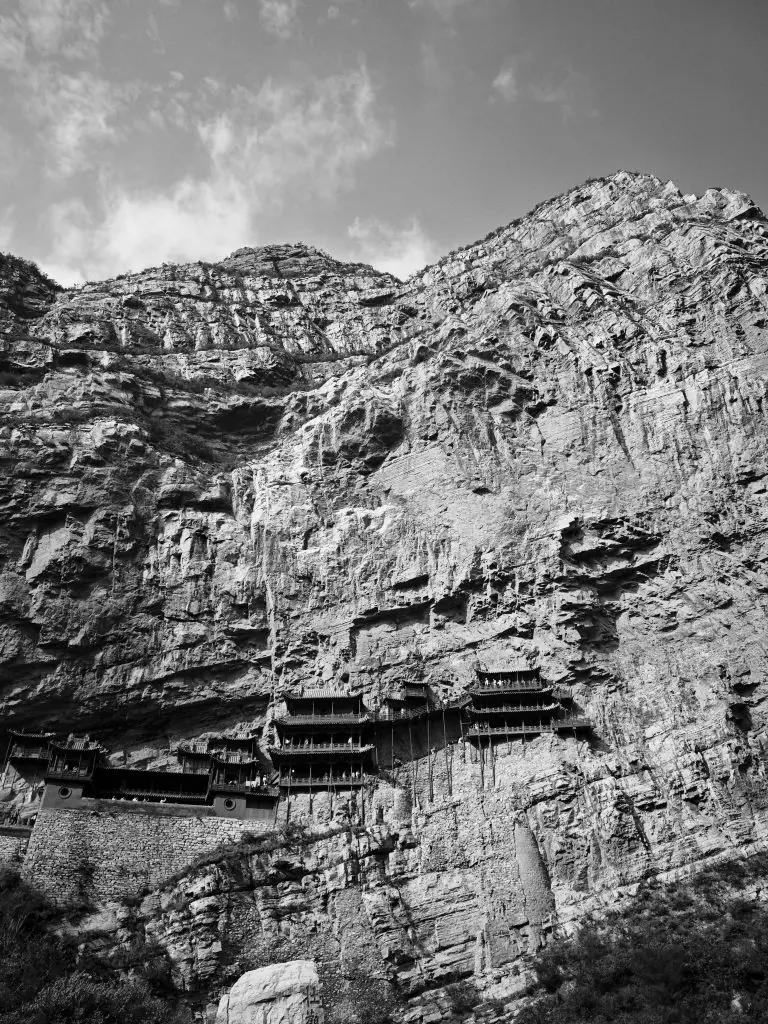
Hanging Temple [shwen-KONG suh] (悬空寺, the monastery pinned into the cliff face near Mount Heng [huhng-SHAHN] (恒山) as if architecture had learned to negotiate with gravity) would be impressive almost anywhere. In Shanxi it works even better after Yungang Grottoes and Yingxian Wooden Pagoda, because by then you are already primed to look at material decisions rather than photograph alone. Drama alone does not explain the hold it has. What matters is that Shanxi keeps making architecture answer difficult conditions directly.
Yanmen Pass [yen-men] (雁门关, the northern gate where frontier pressure, military movement, and the memory of defense stop feeling abstract) then expands the province again. Shanxi is also a place shaped by routes, threat lines, and strategic depth. Once Yanmen enters the story, the sacred spaces no longer feel insulated from the harder conditions around them. They are part of the same world.
Jinci Temple, Pingyao Ancient City, and the Wang Family Compound Turn Space Into Social Order
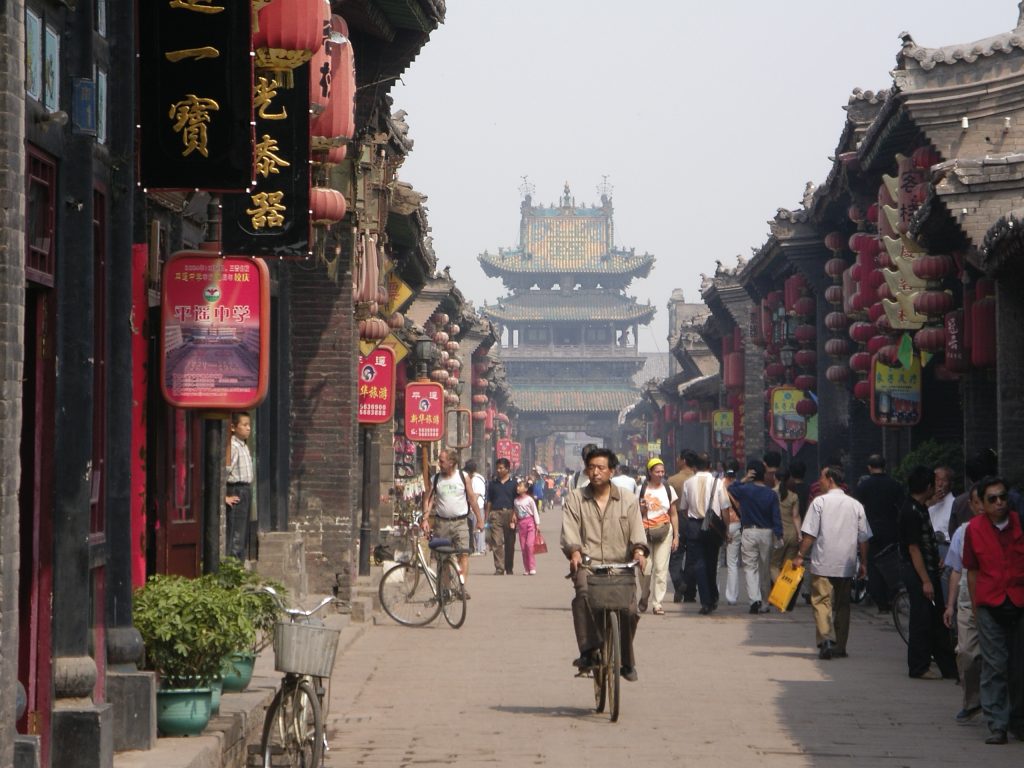
The middle movement of the route is where Shanxi stops being only visually impressive and starts becoming socially legible. Jinci Temple [JIN-tsuh] (晋祠, the spring-fed shrine complex near Taiyuan where Song clay attendants, dark timber, and old cypresses make ritual space feel alive rather than frozen) slows the eye down first. It teaches you to notice continuity, pacing, and material depth.
Then Pingyao Ancient City [PING-yow] (平遥古城, one of the clearest surviving late-imperial merchant and banking towns in China) shows what happens when order turns commercial. Here walls, streets, courtyards, and former banking institutions all still cooperate. After that, Wang Family Compound [wahng] (王家大院, the vast courtyard estate where merchant wealth hardens into family hierarchy and domestic discipline) sharpens the point. Jinci Temple gives you ritual order. Pingyao Ancient City gives you urban and financial order. Wang gives you household order. Seen in that sequence, Shanxi stops feeling random and starts feeling internally consistent.
Hukou Waterfall and Zhangbi Castle Bring in Force, Risk, and Survival
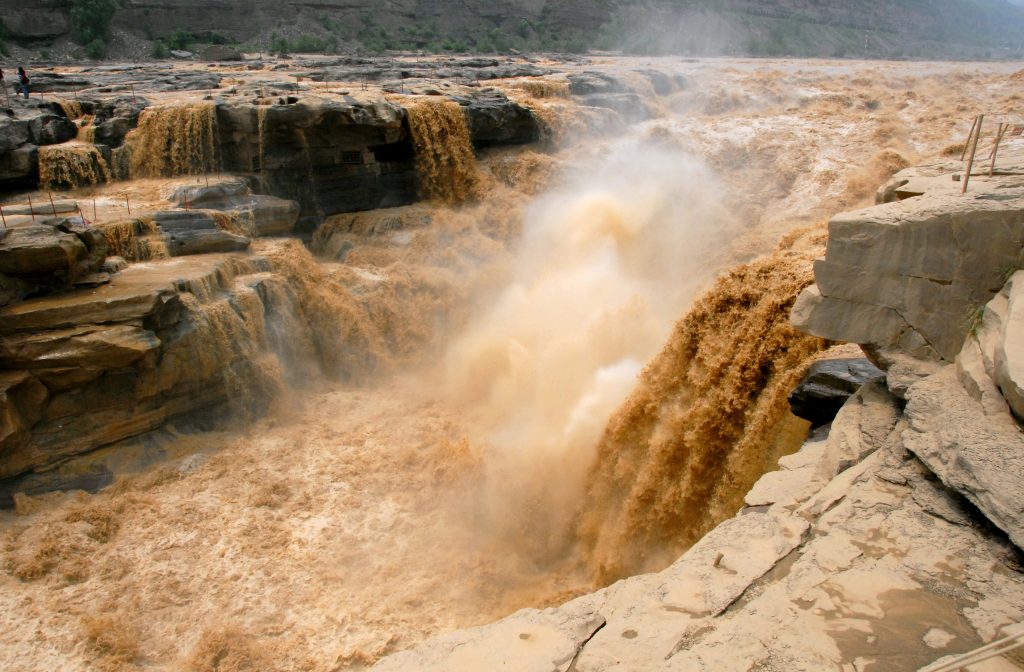
If the route ended with merchant elegance, Shanxi would be easier but flatter. It needs a harder finish. Hukou Waterfall [HOO-koh] (壶口瀑布, the Yellow River narrowed into a roar of spray, compression, and raw momentum on the Shanxi-Shaanxi border) makes that happen immediately. You hear it before you see it — a low, rolling thunder that climbs through the gorge and sits in your chest. The mist kicks up in sheets where the river drops through the slot, soaking the rock and your shoes, and the sound is so constant it stops registering as noise and becomes the texture of the place itself. The province’s story extends past religion, craft, and wealth into geology, force, and the practical difficulty of living in a region shaped by plateau edges and river systems.
Zhangbi Castle [jahng-BEE] (张壁古堡, the compact fortified settlement whose tunnels and defensive logic make security feel like part of everyday life rather than a separate military chapter) completes that correction. By this point in the route, the province is no longer readable as a museum display. It is a place where belief, structure, trade, family order, terrain, and self-protection all belonged to the same historical world.
Worth noting: the 10-day route behind this article is built to deliver Shanxi in exactly this sequence — north-to-south, sacred-to-structural, merchant-to-river — so the connections land without you having to engineer them. Shanxi · Sacred Stone & Merchant Heritage – 10 Days 9 Nights.
The 10-Day Order vs. DIY Point-Collecting
The live 10-day Shanxi sequence works better than most self-built versions for a specific reason. A first-time visitor trying to optimize only for fame will often overconcentrate on one register of the province and miss the rest. They may do Datong for the big-name monuments, jump to Pingyao Ancient City for merchant atmosphere, and leave thinking Shanxi was interesting but somehow still disconnected. The route works because it moves in intelligible chapters. North-to-south, sacred-to-structural, frontier-to-mercantile, then river-and-fortification is not arbitrary. It is the cleanest way to let the province keep explaining itself.
It also lowers the burden on the traveler. You do not have to invent the narrative after the fact. You do not have to figure out which site should come before which one in order to make the next stop more readable. The route does that work for you. Instead of collecting individual highlights and hoping meaning will emerge later, you travel through a sequence that steadily sharpens the whole place into focus.
That is what makes this route useful even for travelers who already know the names. Shanxi is not difficult because it lacks strong places. It is difficult because its strongest places belong to a larger story that only appears when the order is right. Once the sequence lands, it stops feeling scattered. It starts feeling inevitable.
Shanxi wins by becoming clearer with every stop. The right route does more than move you around. It teaches you how the place fits together.