

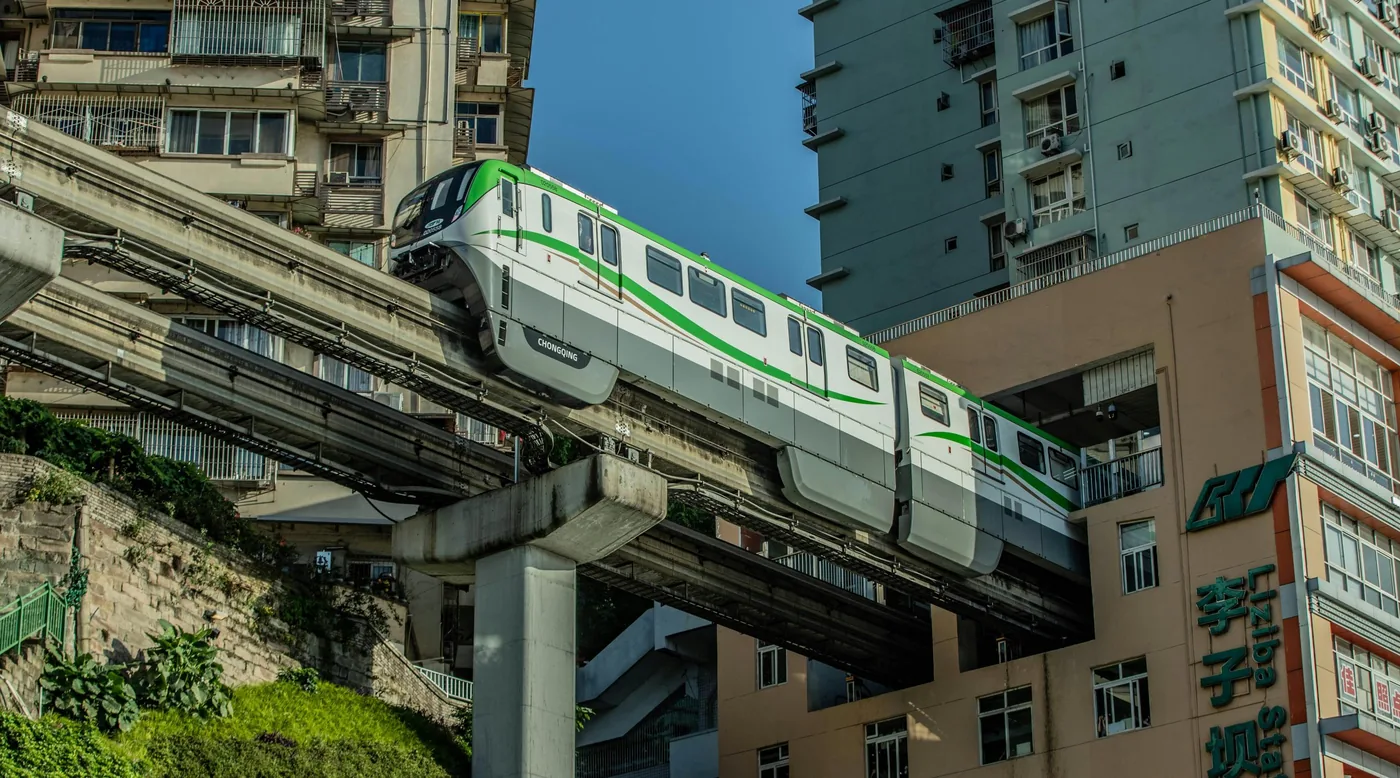
At Liziba in Chongqing, phones are already up. A few hundred people crowd the viewing platform, all facing the same 19-storey apartment block — then a Line 2 monorail slides out of the eighth floor on rubber tires, almost silent, while laundry hangs on the balconies above.
The crowd reacts the same way every time: a small collective gasp, then laughter, then everyone checks their screen to see if they caught it. The story most people tell about this place is wrong. The standard line — Chongqing needed a monorail and threaded it through an existing apartment building — sounds right because it sounds impossible. The reality is less cinematic and more interesting.
Liziba [lee-zuh-BAH] (李子坝, the Line 2 monorail station) was never a retrofit. The station and the building were designed together starting in 1998 and built together from 2000. Neither came first. This is one structure with two lives.
One Structure, Two Systems
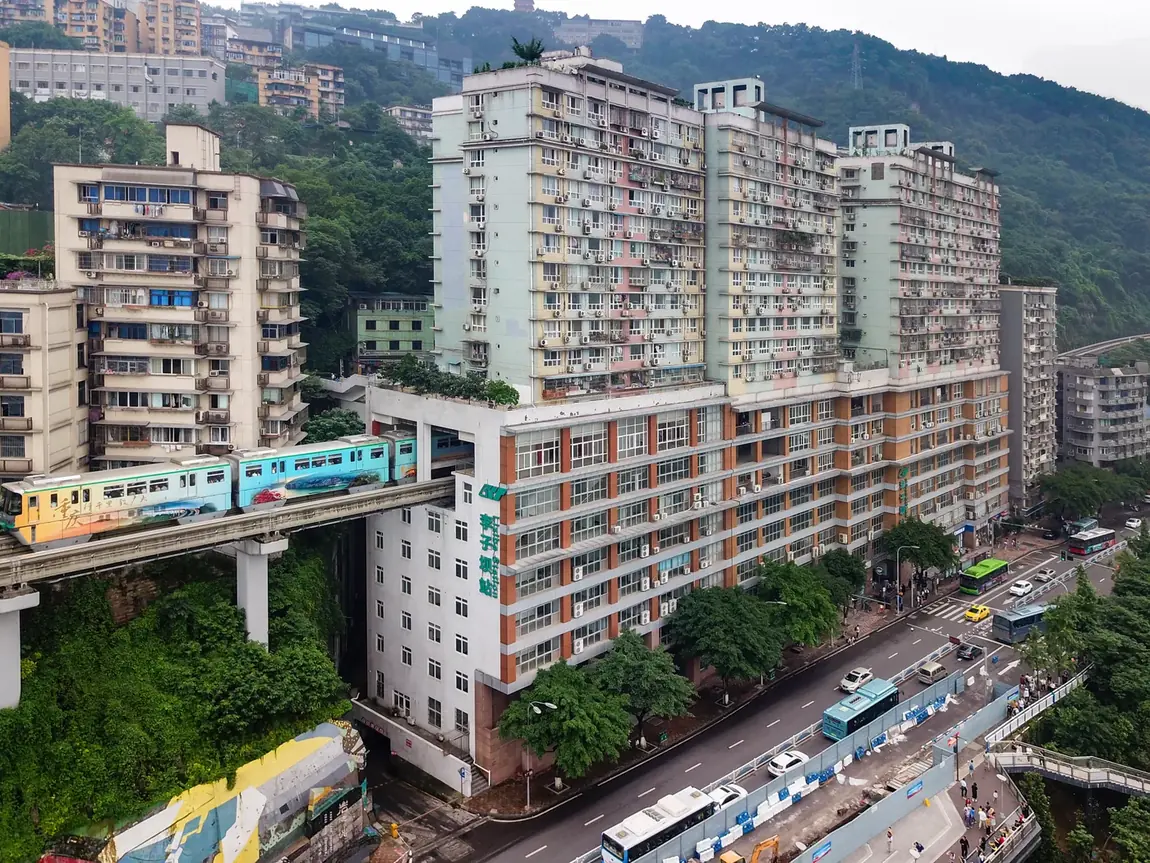
From the outside, building and railway look fused. They are not. The design uses what engineers call “station-bridge separation”: six pillars carrying the rail track and roughly ninety pillars holding up the building sit on completely independent foundations. Between them, a 20-centimetre gap — about the width of a hand — prevents any vibration from crossing between the two systems.
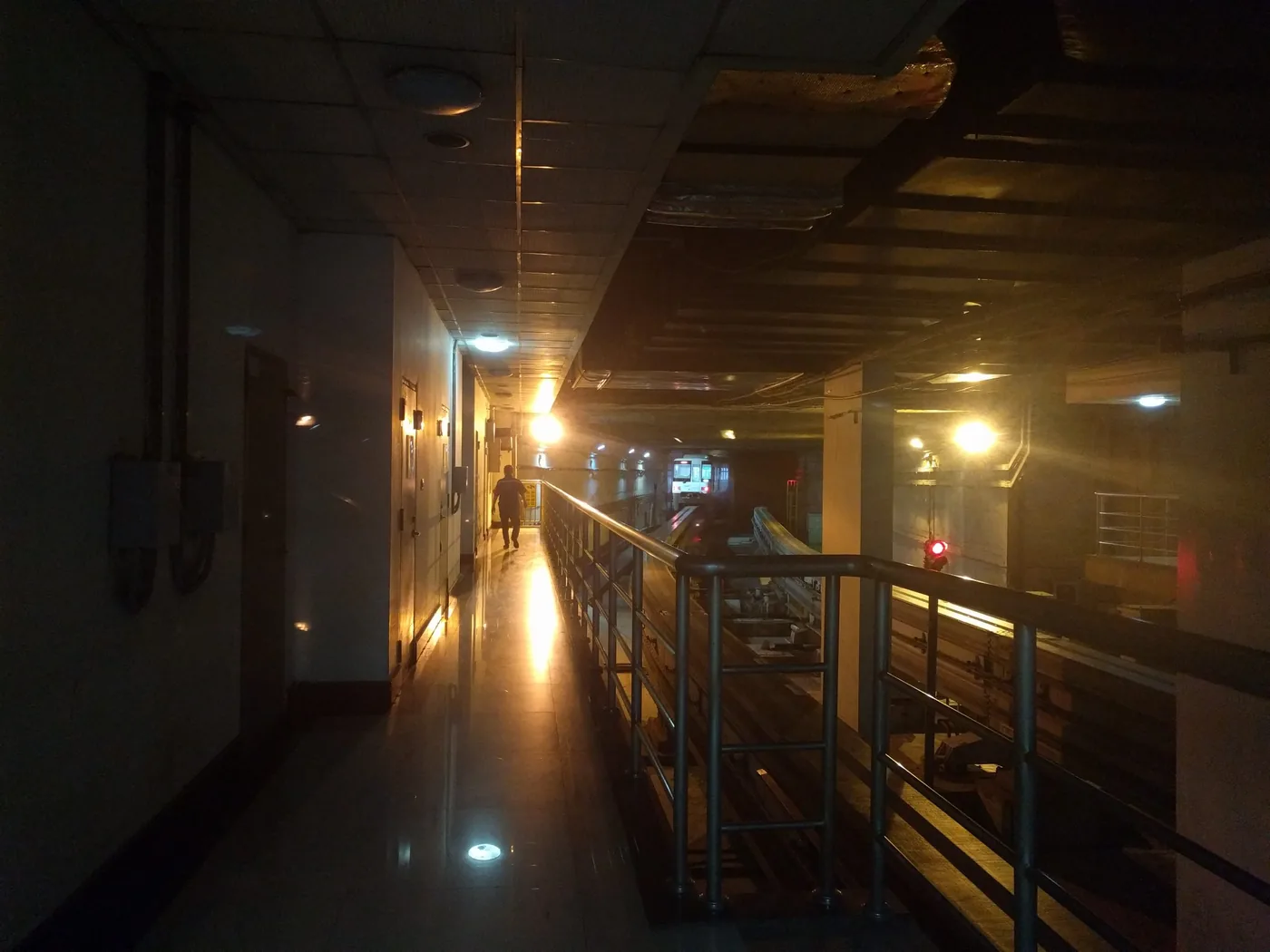
The building divides cleanly. Floors one through five are commercial. Floors six through eight belong to the railway — equipment on six, the station hall on seven, the platform on eight. Floors nine through nineteen are residential apartments. The train crosses 132 metres through the structure. The vertical gap between the platform level and the first apartment above it is 5.1 metres. That is the entire buffer between a monorail and someone’s living room.
The reason passengers feel almost nothing is the wheels. Line 2 monorails run on inflatable rubber tires with air-spring suspension, not steel on steel. Operational noise measures below 75.8 decibels — quieter than the traffic on the road outside. Designer Ye Tianyi, a professor at Chongqing University’s School of Civil Engineering, put it plainly: “Both the track and the residential building were designed and constructed at the same time, with no priority.” The project would have been impossible, he added, if either structure had existed first.
The Platform Below
The viewing platform exists because of what happened without it. When Liziba went viral on Chinese short-video apps around 2017, tourists started spilling off the pavement and into traffic to watch the train. By 2018, the city built a dedicated platform — roughly 1,500 square metres of standing room, photography area, and glass-trestle viewpoint — directly below the building.
The spectacle is partly the train and partly the crowd. One visitor described the real show: “watching everyone go from just standing around waiting, to the mass excitement when the train is seen approaching.” There is a shared silence, then the train glides in or out, and the reaction is genuine — phones up, gasps, someone laughs. A train arrives every few minutes, and the cycle repeats.
Not everyone is swept up. Some visitors who already know the visual from video arrive expecting the scale alone to carry thirty minutes, and leave calling it overhyped. The visitors who leave most impressed tend to be the ones who learn the real story: this was always the plan, both structures rose together, and the engineering that makes it quiet is the part you cannot see.
On the way down from the station, expect a gauntlet — the exit funnels passengers through several floors of a shopping complex, vendors on the street below are persistent, and photography-service hawkers line the platform edge. The tourist infrastructure around Liziba is aggressive. The moment itself is not.
A City That Builds Through the Hill
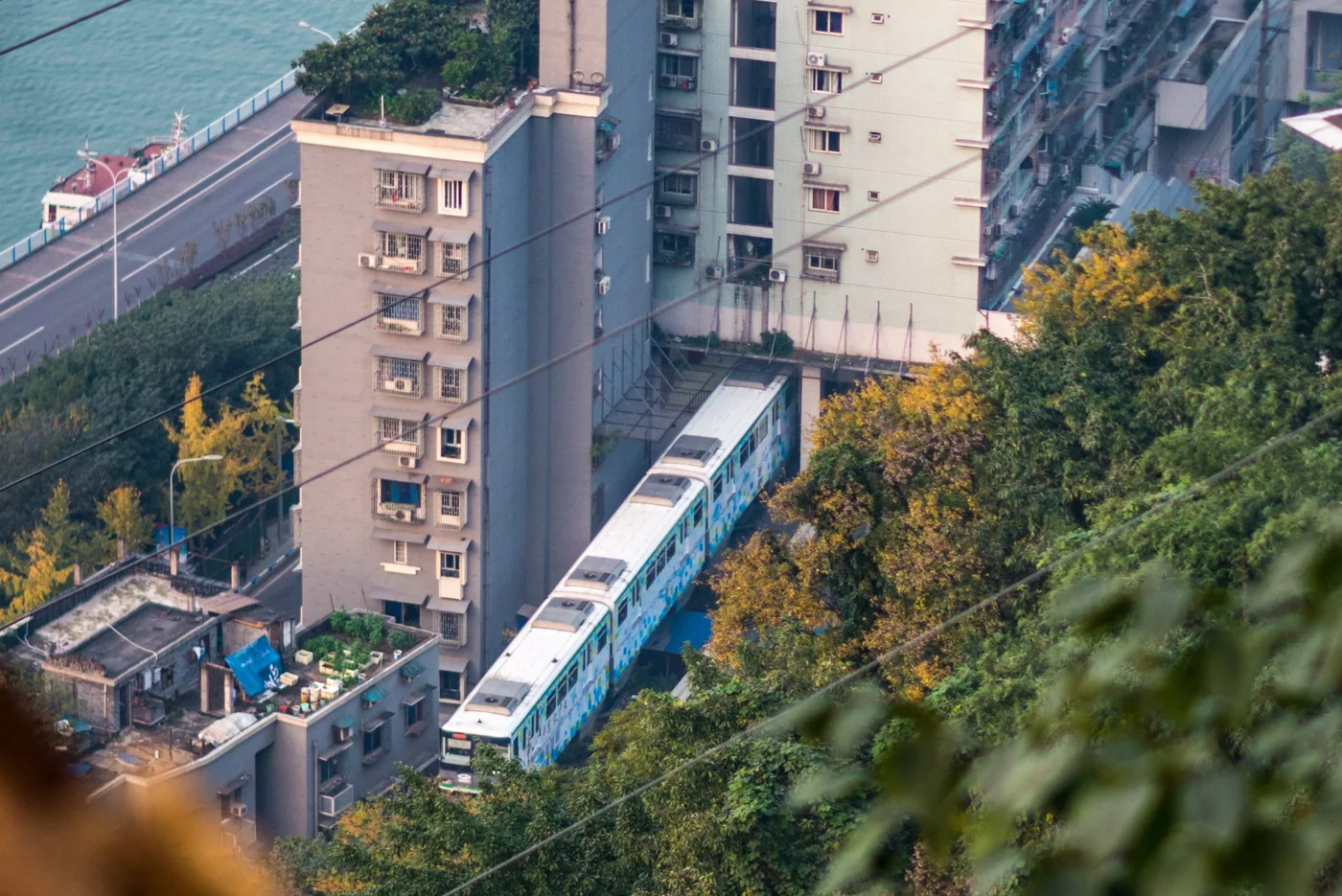
Liziba exists because of terrain. A slope of 20 to 30 metres rises to the north. The Jialing River runs along the south. There was no room for a conventional station and no space to move either the railway or the planned apartment building. The solution was to stop treating them as separate projects.
This is the same logic that produced Hongya Cave (Hongyadong) a few kilometres downstream — the cliffside stilt-house complex that stacks eleven storeys against a cliff face — and the same reason Shancheng Lane still threads its way up the slope above the river. Chongqing does not build around its topography. It builds through it — stacking uses, splitting levels, threading infrastructure through living space.
For Ye Tianyi, the hardest part of the project was not the engineering. It was the meetings — two to three per week with municipal officials and real estate developers for two years. The municipality had to approve what Ye called “special cases with special methods.” Nobody had combined a monorail station and an apartment building before. The bureaucratic buy-in took as long as the structural design.
The same Chongqing logic that threads a monorail through an apartment building also stacks a stilthouse complex on a cliff face and carves a walking lane into a hillside. The itinerary that puts you inside all three is Chongqing & Chengdu · Neon City & Sacred Mountain – 12 Days 11 Nights.
Liziba is famous for looking impossible. The better story is that it was always the plan. Four hundred families have lived above a monorail platform since 2005, and the train has passed through their building tens of thousands of times. The building did not accommodate the train. They grew up together — and that is the part worth knowing before you go.
Image Credits
- Liziba monorail and building (featured) — sam Zheng / Pexels
- Full building view with monorail — W.carter / Wikimedia Commons (CC BY-SA 4.0)
- Station platform interior — Qa003qa003 / Wikimedia Commons (CC BY-SA 4.0)
- Aerial view with Jialing River — Pbrks / Wikimedia Commons (CC BY-SA 4.0)