

At seven in the morning in Chengdu, a man in a white undershirt is already in his bamboo chair, lidded tea bowl beside him, mahjong tiles clicking. Three hundred kilometers east in Chongqing, a porter is hauling a refrigerator up a hillside staircase on a bamboo pole.
Both cities share peppers, dialect, and mahjong — but daily life in each follows a logic the other would barely recognize. They sit at opposite ends of the Sichuan Basin, connected by high-speed rail and several centuries of shared Bashu [BAH-shoo] (巴蜀, the cultural region spanning Sichuan and Chongqing — still the word locals use for “our people”). Chili-fired kitchens, late nights, loud tables: the raw ingredients overlap. Spend a few days in each city and the differences start to feel structural, not cosmetic.
The Terrain That Built Two Personalities
Chengdu [CHUNG-doo] (成都, the capital of Sichuan province, a flat basin city of 21 million where the pace of life has become its defining export) spreads across a plain where streets run in grids and bicycles still make sense. In People’s Park, retirees settle into rattan chairs under ginkgo trees and do not leave until lunch. The flatness is not just geography — it is permission. When a city asks nothing of your legs, daily life can afford to slow down.
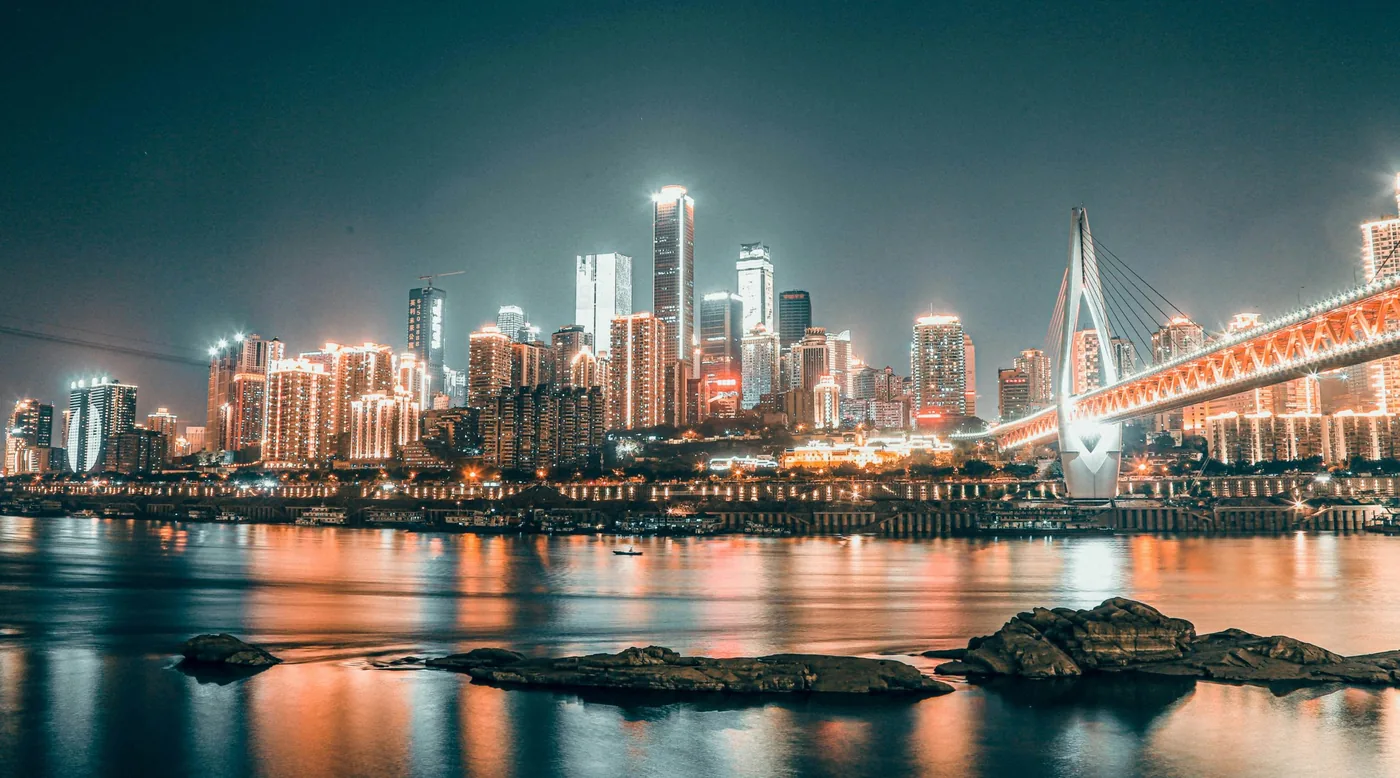
Chongqing [chohng-CHING] (重庆, the mountain municipality carved into ridges above the Yangtze and Jialing rivers) makes no such offer. Walking here means choosing between stairs and more stairs. Escalators tunnel through cliff faces as public transit. Apartment building entrances on the fifteenth floor open directly onto a hillside road. None of this accommodates laziness, and neither does the culture it produces.
Chengdu Sits Down
The most honest map of Chengdu’s daily life is a seating chart. At Pengzhen Tea House, a century-old hall in Shuangliu district, regulars arrive by 4:30 AM. The owner once said that without the shop, many of his elderly patrons would have nowhere else to go — most live alone, and the teahouse is their living room. At Sha River Tea House near Lijiatuo, one man has occupied his table for over twenty years. By evening the tea bowls make way for mahjong tiles, and the games run past midnight.
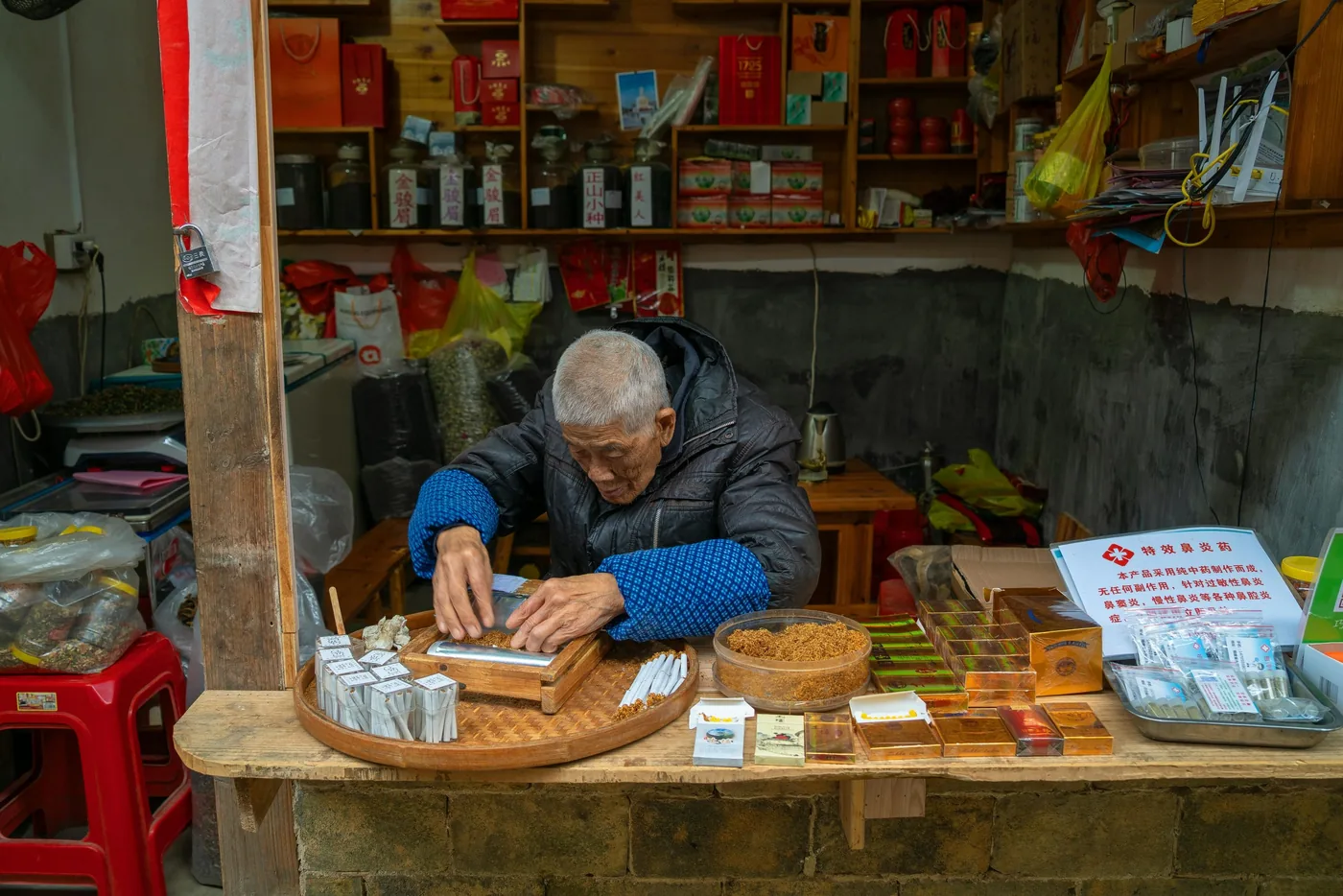
Eating runs on the same logic. Chengdu’s cangying guanzi [tsahng-ying gwahn-zuh] (苍蝇馆子, “fly restaurants” — a once-derisive name for grimy hole-in-the-walls, now a badge of authenticity for no-frills family kitchens) are scattered through 1980s apartment complexes and back alleys across the city. There is no reservation system. A Bentley parks next to a delivery moped and both drivers crowd identical plastic tables for a bowl of braised pig brain and tofu, searing with Sichuan pepper. The food is cheap, fast, and classless — and Chengdu locals will tell you the fly restaurants outperform any restaurant on Jinli by a wide margin.
Underneath all of this runs a philosophy Chengdu people call manmanlai [mahn-mahn-LYE] (慢慢来, “take it slow”). It is not laziness — it is a city-wide agreement that comfort ranks higher than efficiency, visible in the ear-cleaning vendors who set up in parks, the bird owners who display their caged songbirds on morning walks, and the stubborn refusal to rush a meal.
Chongqing Climbs
Chongqing’s culture was built by people who carried things uphill. The city’s bangbang [bahng-bahng] (棒棒, bamboo-pole porters) once formed an informal army of migrant laborers who hauled up to eighty kilograms on their shoulders through steep alleys from sunrise to sunset — even in summers that regularly hit forty degrees. Elevators and delivery apps have mostly replaced them, but the personality the trade produced has not gone anywhere. Chongqing people are direct, physically tough, and impatient with pretense.
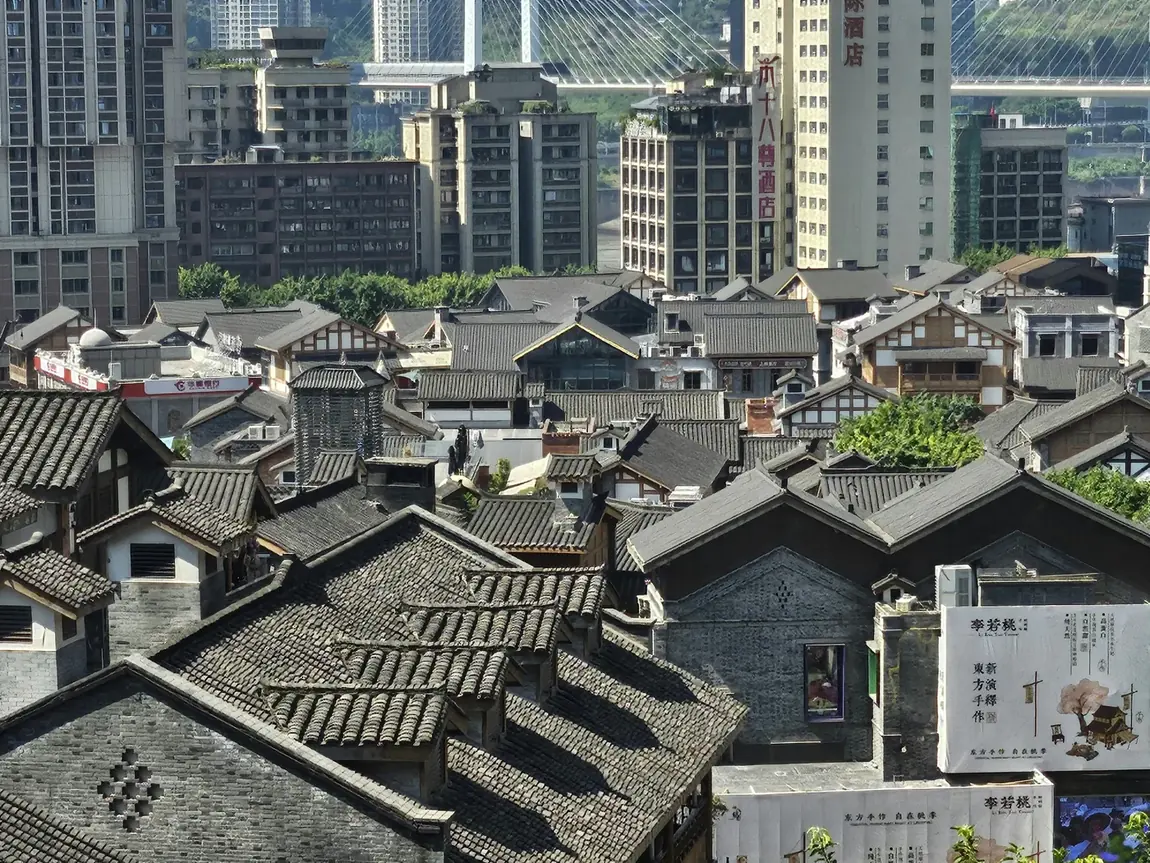
The old neighborhood of Shibati [shih-BAH-tee] (十八梯, “Eighteen Stairs” — the steep stairway passage that once connected upper Yuzhong to the Yangtze riverbank) captured this life in concentrate. Before its demolition in the mid-2010s, the lane was a vertical village: barrel stoves on landings where residents without kitchens cooked flatbread, sewing machines mending clothes on staircases, sparks flying from a key-cutting stall at the corner, the smell of frying tofu drifting between floors. The site reopened in 2022 as a renovated commercial district, but the original neighborhood — where life happened on the stairs, not in parks — is gone.
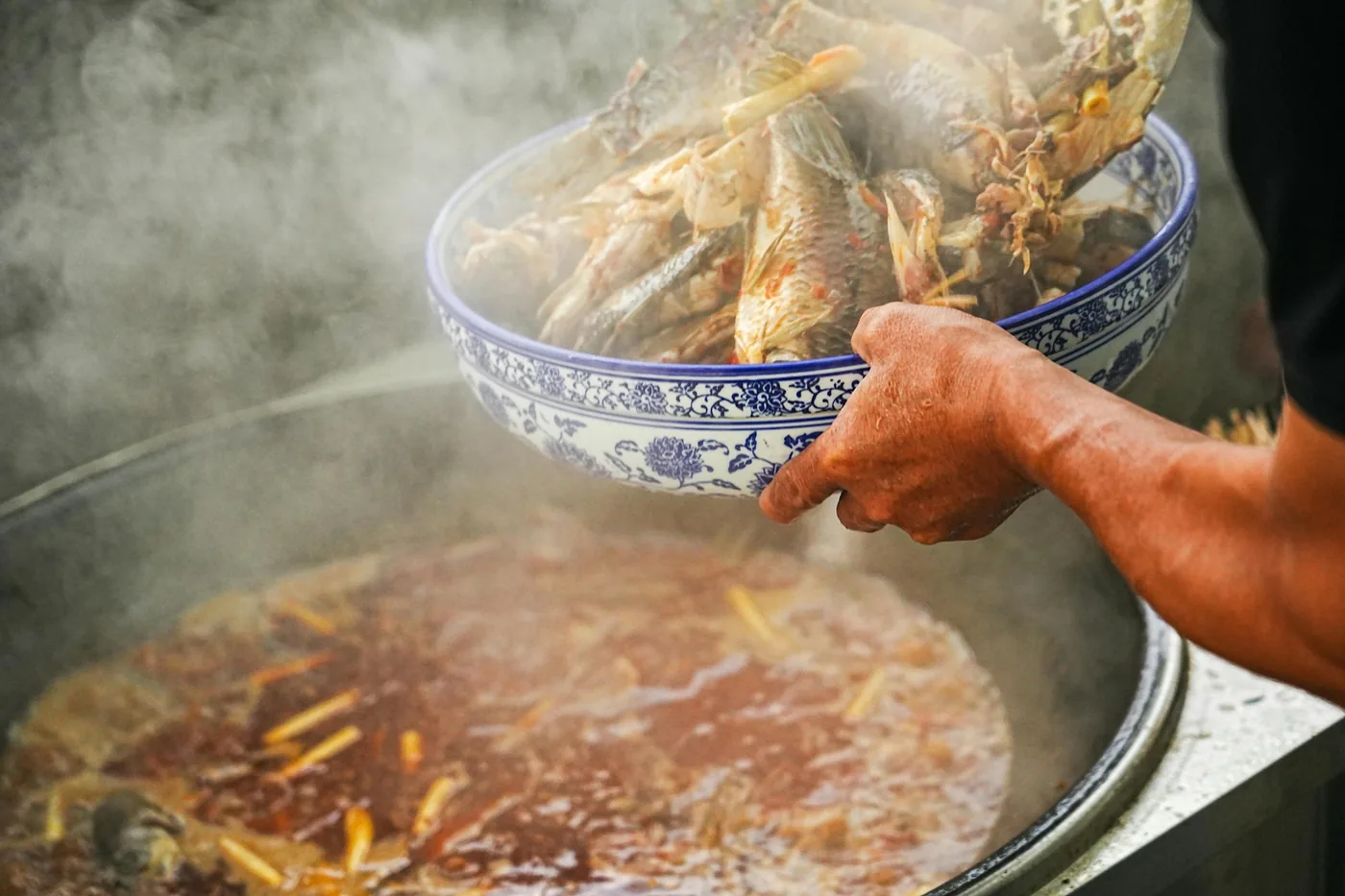
And the food matches the city. Chongqing hotpot was born at Chaotianmen [chow-tyen-MEN] (朝天门, the historic wharf where the Yangtze and Jialing rivers meet) when nineteenth-century dockworkers and porters bought leftover offal from butchers and boiled it in a brutal broth of dried chilies and numbing Sichuan peppercorns to stay warm through winter shifts. The dish still runs on beef tallow and red oil. There is nothing mild about it, and that is the point.
Same Roots, Different Kitchens
The raw ingredients overlap — but what each city does with them diverges sharply at the table.
Sit down at a hotpot table in each city and the difference materializes. Chengdu’s version runs a split pot: one side fiery, one side mild broth, with a wider spread of side dishes — lotus root, potato, mushroom, things that absorb and soften. Chongqing’s pot is a single red lake of beef tallow and dried chili, and the menu leans toward offal, tripe, and duck intestine. Same format, different intensity.
The metaphor holds beyond the table. Chengdu’s nightlife drifts toward jazz bars, rooftop cocktails, and midnight snack runs to fly restaurants. Chongqing’s goes vertical — open-air bars stacked up the cliffside levels of Hongya Cave (Hongyadong), the commercial complex above the river, with drone shows overhead and neon reflected off wet mountain roads. One city sits into its evenings; the other climbs through them.
Ninety Minutes Apart, Two Different Moods
The bullet train between Chengdu and Chongqing takes about ninety minutes — less time than most airport transfers. Step off at Chongqing North and the first thing you notice is the slope: the station exit tilts downhill, the taxi line wraps around a curve, and the skyline stacks vertically against the ridge. After Chengdu’s flat calm, the angle alone resets your posture.
A visitor who sees only one city gets half the picture. Chengdu rewards patience and comfort; Chongqing rewards appetite and effort. Together, they give a fuller, stranger, more honest portrait of China’s southwest than either one alone.