

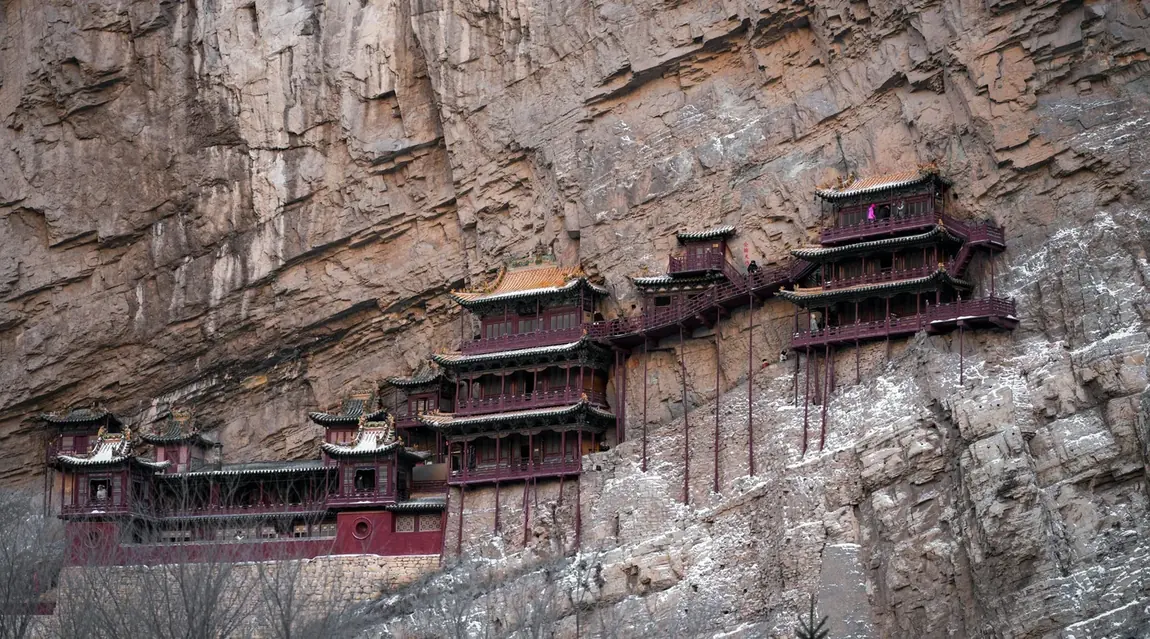
Stand at the base of the gorge and the Hanging Temple barely registers — a scatter of wooden buildings clinging to a wall of grey and ochre stone so vast that the halls and walkways look no larger than birdhouses on a cliff face.
Hanging Temple [shwen-KOHNG suh] (悬空寺, the tri-faith cliff monastery near Datong) is Shanxi’s most visually arresting site — and its most misunderstood. The spectacle makes people assume this was a stunt. The truth is more interesting: every part of the location was chosen for practical reasons, and the engineering that keeps it there is among the most elegant solutions in Chinese architectural history.
The Cliff Up Close
The approach path follows the Hun River gorge toward Hengshan [HUHNG-shahn] (恒山, the Northern Sacred Mountain and the cliff face the temple is built against). From the canyon floor, the temple hangs roughly sixty metres overhead. Visitors who have seen the photos expect to feel impressed. What they actually feel is exposed.
The walkways connecting the halls are five centimetres of wood over open air. The railings barely reach your knees. Wind comes through unglazed windows. On the suspended staircase between the south and north towers — where the passage is wide enough for one person and the cliff drops away on three sides — the loudest sound is your own breathing.
This is not a calm, contemplative place. It is a place that makes your hands grip harder and your steps shorter.
Oak Into Rock: The Hidden Load Path
The secret is not visible from below. Twenty-seven horizontal beams — each about fifty centimetres in diameter, soaked in tung oil to resist rot — are driven deep into the cliff face. The holes carved to receive them are hourglass-shaped: narrower at the mouth, wider inside. The beams are wedged in using the same expansion principle as a modern anchor bolt. Each one bears several tonnes.
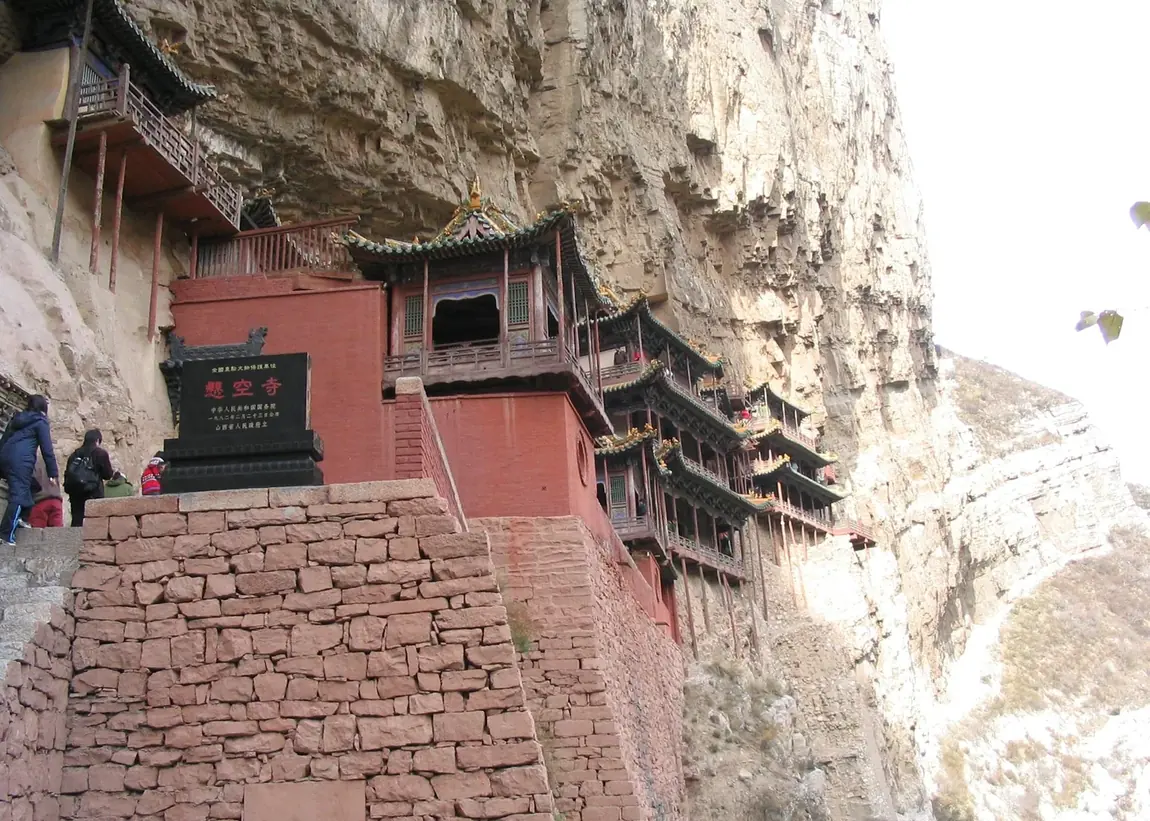
From these crossbeams, the entire structure hangs on a wooden frame joined by mortise-and-tenon joinery — no nails. Dougong [DOH-gohng] (斗拱, interlocking bracket sets that transfer roof weight outward and downward) distribute the load across the frame. The system flexes rather than fights the mountain’s micro-movements.
The wooden pillars visible from below — the ones that look like they hold everything up — are mostly cosmetic. The real load path is hidden in the cliff. During a major renovation in 1978, workers replacing several main beams rediscovered the original joinery system and confirmed what the builders had known all along: the mountain itself is the foundation.
Three Teachings, One Frontier Roof
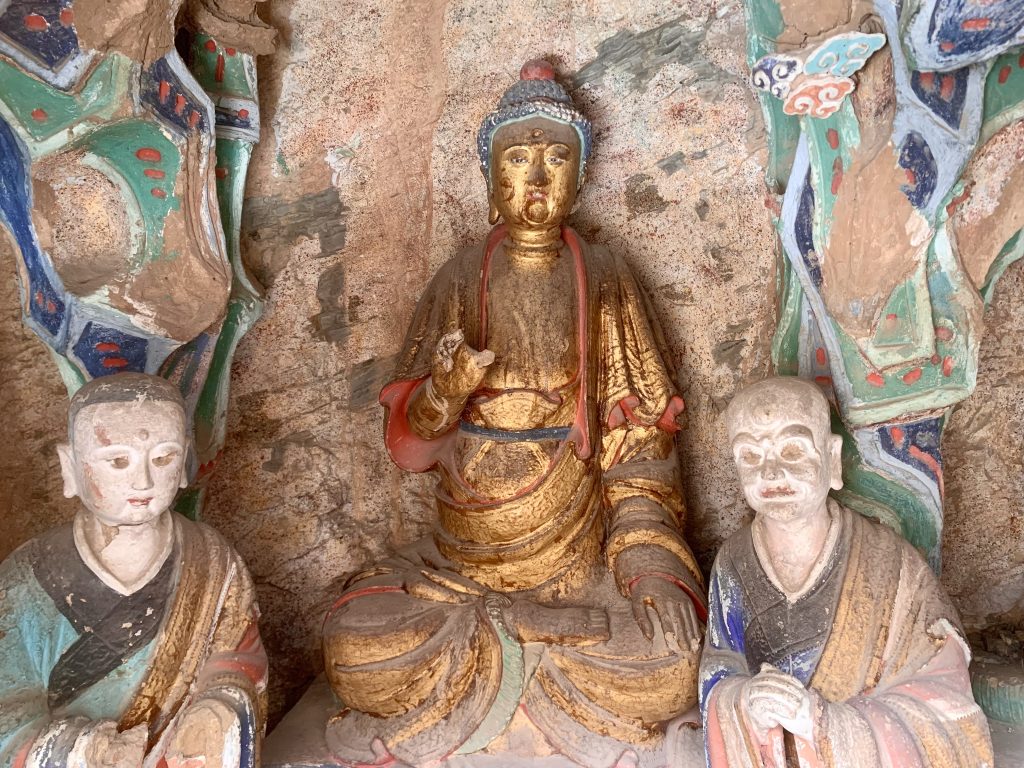
At the highest point of the north tower sits the Hall of Three Religions [sahn-jyow-dyen] (三教殿), a single room where Shakyamuni Buddha occupies the centre, Laozi sits to the left, and Confucius to the right. In most of China, these three traditions maintained separate temples, separate hierarchies, separate patronage networks. Here they share a wall.
The arrangement was not an expression of open-minded tolerance. It was frontier politics. The Northern Wei dynasty (386–534 CE), which commissioned the temple around 491 CE, was ruled by the Tuoba Xianbei — a non-Han people governing a mixed population of Chinese, nomadic, and Central Asian communities. Managing competing religious institutions was a matter of statecraft. Consolidating them under one roof at a strategically placed mountain site was efficient and deliberate.
The south tower still reflects this layered logic. The bottom floor houses Chunyang Palace [choon-YAHNG gohng], dedicated to the Daoist immortal Lu Dongbin. Above it, the Three Officials Hall [sahn-GWAHN dyen] — the temple’s largest room — contains Ming-era clay sculptures of the officials governing heaven, earth, and water. The top floor is the Buddhist Thunder Hall [LAY-yeen dyen]. Walk upward through three floors and you pass through three worldviews. The building’s vertical axis is itself a kind of argument about religious order.
Rain, Rockfall, and River: Reading the Cliff
The Hanging Temple’s location looks reckless until you read the cliff face the way its builders did.
The temple sits in a natural concavity — a recessed section of the rock where the cliff leans inward overhead. This overhang acts as a permanent awning, shielding the wooden structure from rain, snow, and direct sunlight. Above the temple, the builders carved a drainage channel into the mountain to divert rockfall and runoff away from the buildings. Below, the canyon floor is the Hun River floodplain. Building at ground level here would have meant periodic destruction.
The Daoist principle guiding the site selection survives in a phrase attributed to the temple’s legendary founder, the Northern Wei monk Liaoran: “上延霄客,下绝嚣浮” — reach toward heaven, cut off worldly noise. The spiritual aspiration was real. But so was the geological logic. The location that best served meditation also happened to be the one that best served preservation.
Fifteen centuries later, the proof is the building itself: still standing, still functional, still making visitors grip the railings a little tighter.
The Shanxi circuit that connects the Hanging Temple, Yingxian Wooden Pagoda, and the Yungang Grottoes — places that survived by being hard to reach — runs through Shanxi · Sacred Stone & Merchant Heritage – 10 Days 9 Nights.