

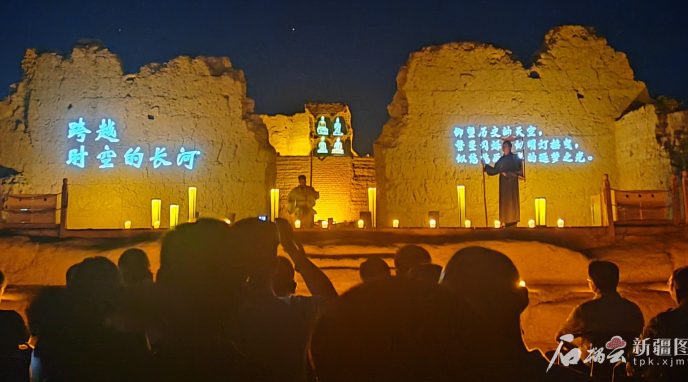
At the end of a Turpan [TOOR-pan] day, when the heat finally begins to leave the ground, Jiaohe Ancient City stops reading like a ruin and starts reading like a stage set.
Jiaohe Ancient City [JEE-ow-huh] (交河故城, the 2,000-year-old Silk Road fortress outside Turpan) sits on a flat plateau between two river valleys. That shape matters. The site does not feel built on top of the landscape so much as cut out of it, as if the ground itself learned how to hold a city.
By late afternoon, the earthen walls have already started to take on the day’s last warmth. The color shifts from chalky beige to something closer to baked gold, and the whole site becomes easier to read. What looked severe at noon starts to feel intentional: the plateau rim, the open sky, the empty space that once made defense possible.
A City Built by Terrain, Not by Walls
The first thing to understand about Jiaohe is that it was not protected in the usual way. It was protected by height, narrow approaches, and the drop to the riverbeds below. That is why the site still feels unusually complete even in ruin. The plateau does part of the work a city wall would normally do.
For English-speaking travelers, that is the easiest way into the history here: stand on the rim and look down, then look back across the open middle of the site. The story stops being abstract. The city’s logic is visible in the terrain itself. Streets, courtyards, temples, and administrative spaces were not arranged for postcard symmetry. They were arranged to make life possible on a cliff-backed island of earth in the middle of the desert edge.
When the Light Does the Work
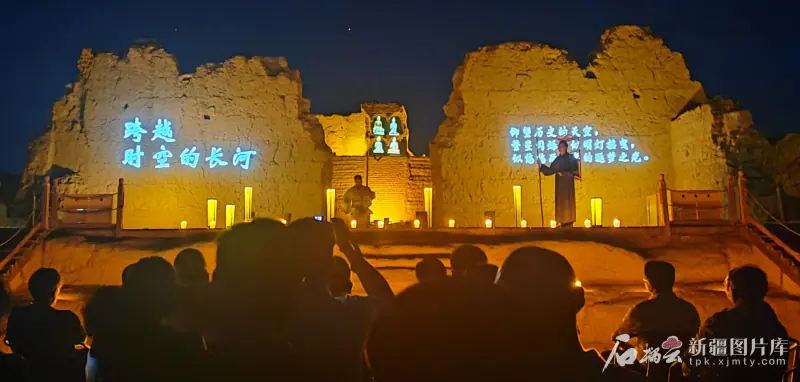
This is where Jiaohe becomes something more than a heritage stop. As dusk settles, the site loses the hard glare that flattens earthen ruins and starts to recover depth. The broken walls stop blending into the ground. Openings reappear. Edges sharpen. The fortress starts to read as a place with sequence instead of a pile of remnants.
The night-tour format matters because it gives the ruin sound as well as light: a live performance, projected images, and the sense that the old city is being used again, not just admired from behind a rope. The heat breaks, the wind moves through the open streets, and the site becomes theatrical without becoming fake.
Turpan’s climate helps the effect. The dryness keeps the earthen surfaces distinct after dark, and the open air keeps the whole experience from feeling enclosed. Jiaohe does not ask for reverence in a quiet museum voice. It asks the visitor to notice how light, sound, and emptiness can work together in a place that once had real civic weight.
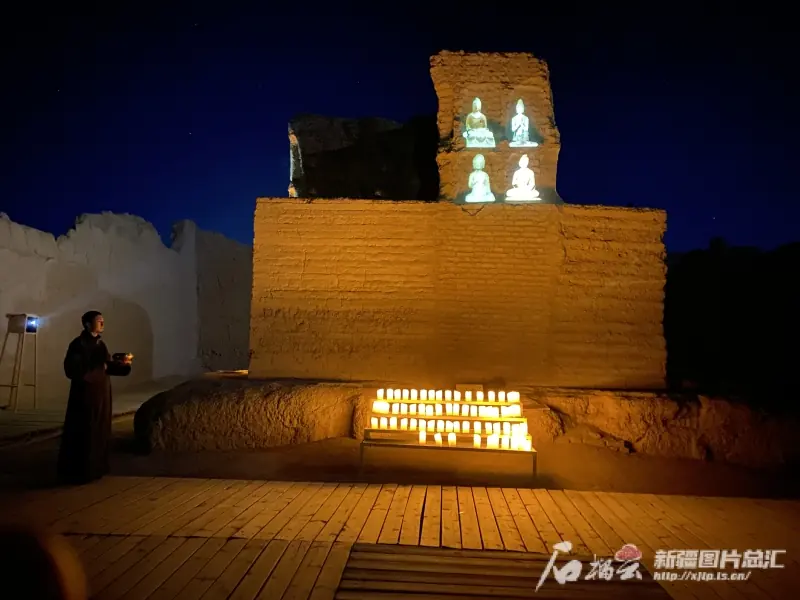
How Dusk Restores the City’s Logic
The most interesting part of the site may be the one that sounds least dramatic on paper: the street grid. Once you understand that Jiaohe was an earthen city built to function in a harsh, dry climate, the layout starts to make sense in a way that a textbook description never quite does. The central paths, the temple quarter, and the residential zones all feel like a single answer to one problem: how to build a city where the land itself is the defense.
That is why the ruin works so well in the evening. The dry air keeps the walls crisp. The low light gives the broken edges back their relief. You start noticing how the city was assembled from the ground up rather than placed neatly on top of it. The result is less picturesque than a preserved facade, but far more convincing. It feels occupied by logic, not nostalgia.
Seen that way, Jiaohe is not a place where history sits still. It is a place where time keeps changing the angle of the same forms. At noon, you get geometry. At sunset, you get atmosphere. At night, you get the stage.
The Night Tour Makes the Title Literal
That last move is what the Turpan concert adds. According to the live Xinjiang route, the group reaches Jiaohe at the end of the day, when the sun drops and the performance begins inside the ruins. The concert does not overwrite the site’s meaning. It clarifies it. A city that once organized movement, power, and daily life now organizes light, sound, and attention.
If the article works, it is because the reader can feel that transition happen. Jiaohe is not simply a famous ruin in western China. It is one of the rare heritage sites that becomes more distinct precisely when the day ends. The fortress, the plateau, and the performance all push in the same direction: this is a place that still knows how to hold a crowd.
That is the useful version of the stop for a traveler. Not “an ancient city worth seeing,” but a ruin that changes register after sunset and earns its performance setting instead of borrowing it. In Turpan, that distinction matters. It is the difference between looking at history and watching it activate.
If you want Jiaohe at the moment it becomes most itself, the route that gives it that sunset stage is Full Xinjiang Arc · Silk Road by Luxury Train – 16 Days 15 Nights.