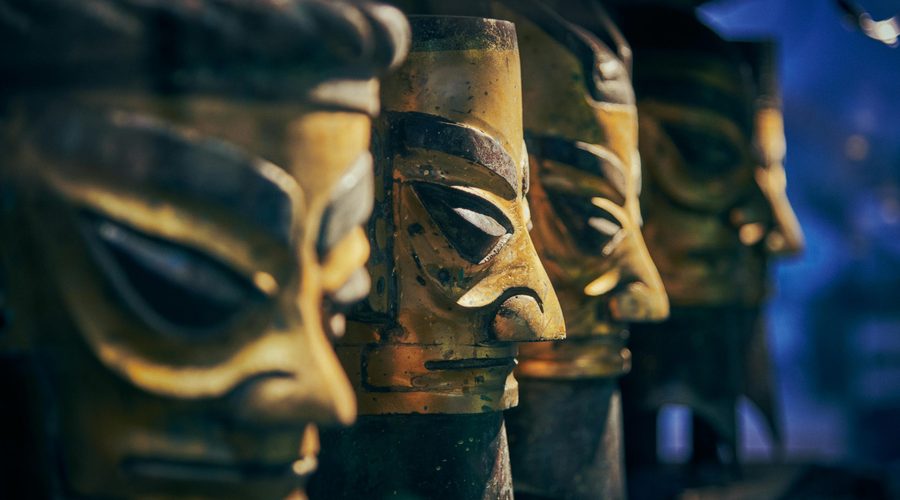
The eyes reach you before the face does. Ten centimetres of bronze cylinder project outward from each socket, aimed at whoever stands in the dim gallery light. Nothing in this face invites warmth — and nothing else in Chinese art, at any point in three thousand years of it, looks remotely like what waits inside Sanxingdui Museum.
Sanxingdui Museum [sahn-shing-DWAY] (三星堆博物馆, where China’s most anomalous Bronze Age civilization surfaces — monumental in bronze, sophisticated in trade, and entirely without written language) sits in Guanghan, sixty kilometres north of Chengdu, at the edge of a flat agricultural plain that gives no hint of what lies beneath it. The civilization that made these masks could cast bronze at a scale that rivalled anything on earth. They left behind no writing — not a single readable sentence. The site spans twelve square kilometres, and archaeologists estimate they have uncovered less than one-thousandth of what remains underground.
Broken, Burned, Buried
In July 1986, workers at a brickyard near Guanghan hit something hard in the clay. They had struck the edge of a sacrificial pit — and within weeks, a second pit was found thirty metres away. What came out of those two holes overturned decades of assumptions about early Chinese civilization.
The objects had been deliberately broken, set on fire, and buried. Bronze heads with gold foil pressed over their features. A gold-sheathed sceptre, 1.4 metres long — the only one of its kind from ancient China. A bronze standing figure, 2.6 metres tall including its base and weighing 180 kilograms, the largest ancient bronze statue ever found in China. And the masks: dozens of them, with angular cheekbones, slit mouths, and those projecting cylindrical eyes that look like nothing any other Bronze Age civilization produced.
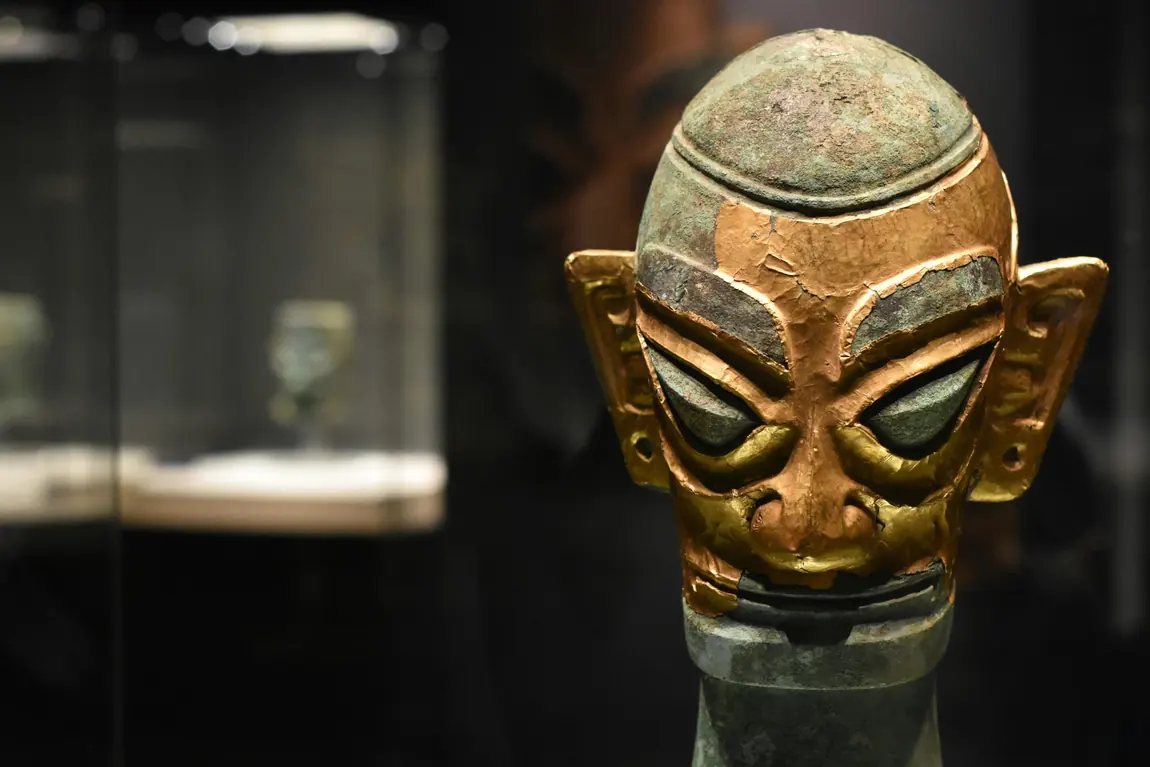
Between 2020 and 2022, six more sacrificial pits were excavated. They yielded over 13,000 additional artifacts: a gold mask that is 84 percent pure gold and weighs 280 grams, silk residue woven on looms that predate known Chinese textile records, and bronze figures so detailed that researchers could identify individual hairstyles and ankle bracelets. The excavation reports described what they had found as “an artistic style completely unknown in the history of Chinese art.”
Mastery Without a Written Word
Here is what makes Sanxingdui genuinely strange, not just impressive. The Shang Dynasty, which ruled central China at roughly the same time, inscribed oracle bones, marked their bronze vessels with clan names, and left behind enough text to fill libraries of scholarly debate. Sanxingdui left nothing readable. A few isolated pictographs appear on scattered artifacts — but nothing that constitutes a writing system, nothing that has been deciphered, nothing that names a single ruler or records a single event.
The gap is not an accident of preservation. This civilization poured its resources into objects that were built to speak — a sacred bronze tree, nearly four metres tall, the largest such artifact from any ancient civilization, with nine branches holding birds that face outward as though broadcasting a signal. A standing figure whose empty hands curve around something that no longer exists. Masks whose features were painted: black pigment on the eyebrows and eyes, vermilion on the lips. These colours, discovered during the 2025 Sanxingdui Forum, pushed back China’s painted-metal timeline by a thousand years.
The objects were the communication. Where the Shang wrote, the Shu Kingdom cast and burned and buried. The masks may have been mounted on wooden supports and worn or displayed by ritual performers impersonating ancestral spirits — the object itself carried the meaning that other civilizations put into sentences. The deliberate destruction in the pits was not disposal. It was transmission: breaking the vessel to release whatever it held.
A Parallel Bronze Age the Textbooks Missed
For most of the twentieth century, Chinese civilization was taught as a single current flowing from the Yellow River valley outward. The story was tidy: Shang Dynasty centres in Henan, bronze technology spreading from north to south, everything important radiating from one heartland. Sanxingdui cracked that model open.
A parallel Bronze Age power had flourished in the Sichuan basin at the same time — casting bronzes of equal or greater scale, trading for ivory from as far as South Asia, and developing an aesthetic so different from Shang norms that early researchers questioned whether the objects could be Chinese at all. The protruding-eye masks have no parallel in Shang art. The sacred tree with its birds and serpent belongs to a cosmology that shares motifs with the Shang’s four celestial animals but renders them in a language entirely its own.
The Sanxingdui civilization thrived for roughly 350 years and then vanished. An earthquake around 1,000 BCE may have diverted the rivers that sustained the city. The successor culture at Jinsha Site [jin-SHAH], forty kilometres away in modern Chengdu and discovered in 2001, inherited some motifs — but not the monumental scale, and not the unnerving strangeness of those projecting eyes.
The New Building Finally Gives the Objects Room
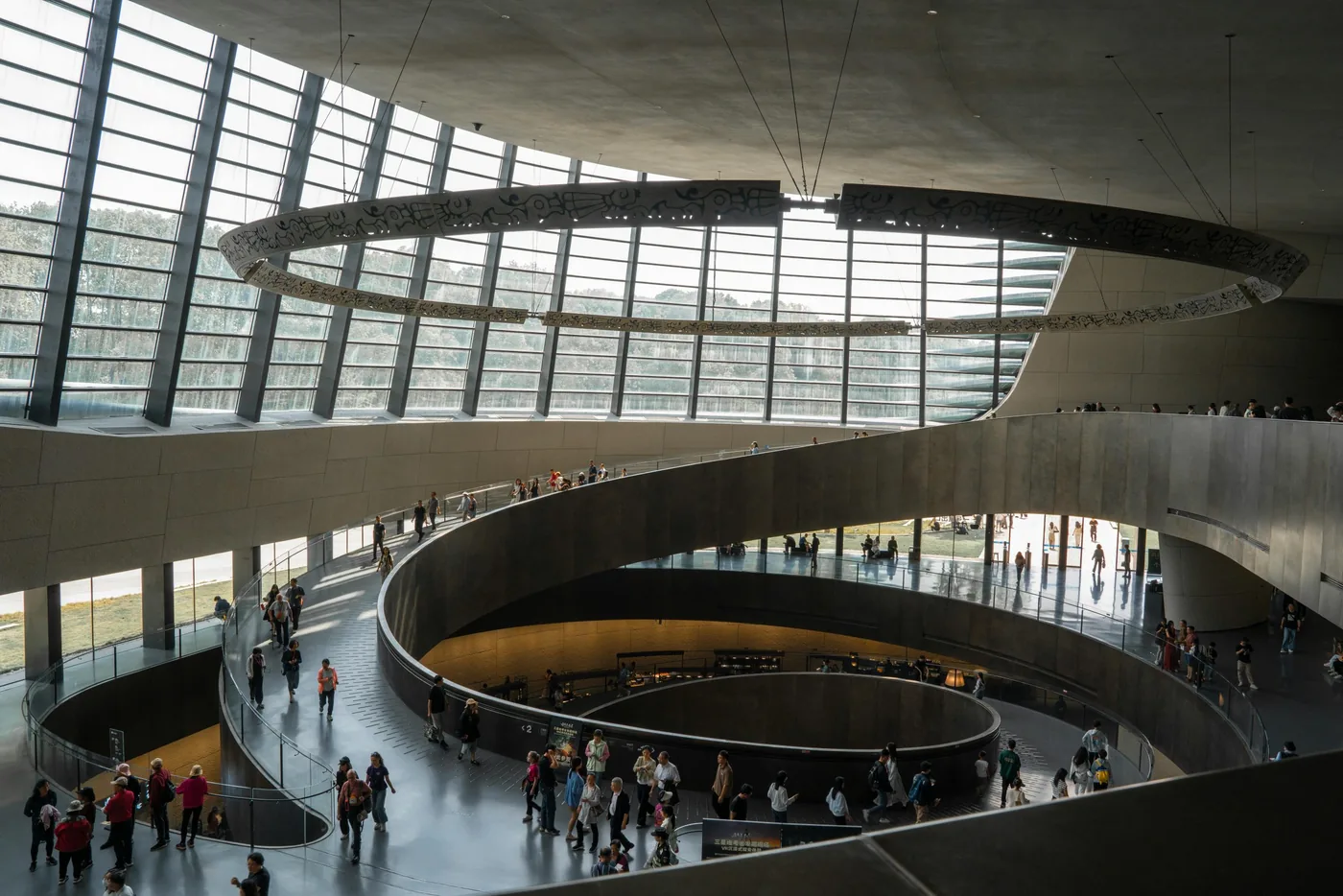
The new museum building, opened in late 2023, doubled Sanxingdui’s exhibition space. A concrete ramp spirals upward through the interior like the inside of a shell — TIME named the museum one of the World’s Greatest Places of 2024, and the architecture earns that, carrying visitors past galleries arranged so that the earliest finds sit at ground level and the newest excavations wait near the top. The building does not compete with its contents. It gives them room.
What earns the visit is not the quantity of objects but the details that shift once you know to look. The standing figure’s hands grip air — whatever they held was wooden, organic, long gone. The sacred tree’s nine branches are not symmetrical; they are deliberately varied, each bird turned at a different angle, as though the whole structure is mid-motion rather than at rest. The faces of the large masks are not symmetrical either. One brow sits higher than the other. The mouths tilt. These are not manufacturing flaws. They are choices — made by people who could cast a four-metre tree in bronze but chose to leave every face slightly off-balance, slightly alive.
No inscription explains any of this. No label in any ancient language tells you what the tree meant or why the eyes project outward or what the standing figure once held in those curving hands. The makers did not write their answers down. They cast them in bronze — and then burned them.
The deep-guided visit to Sanxingdui on Day 7 of our Chongqing-Chengdu itinerary is where the masks stop being spectacle and start making sense. Chongqing & Chengdu · Neon City & Sacred Mountain – 12 Days 11 Nights.