
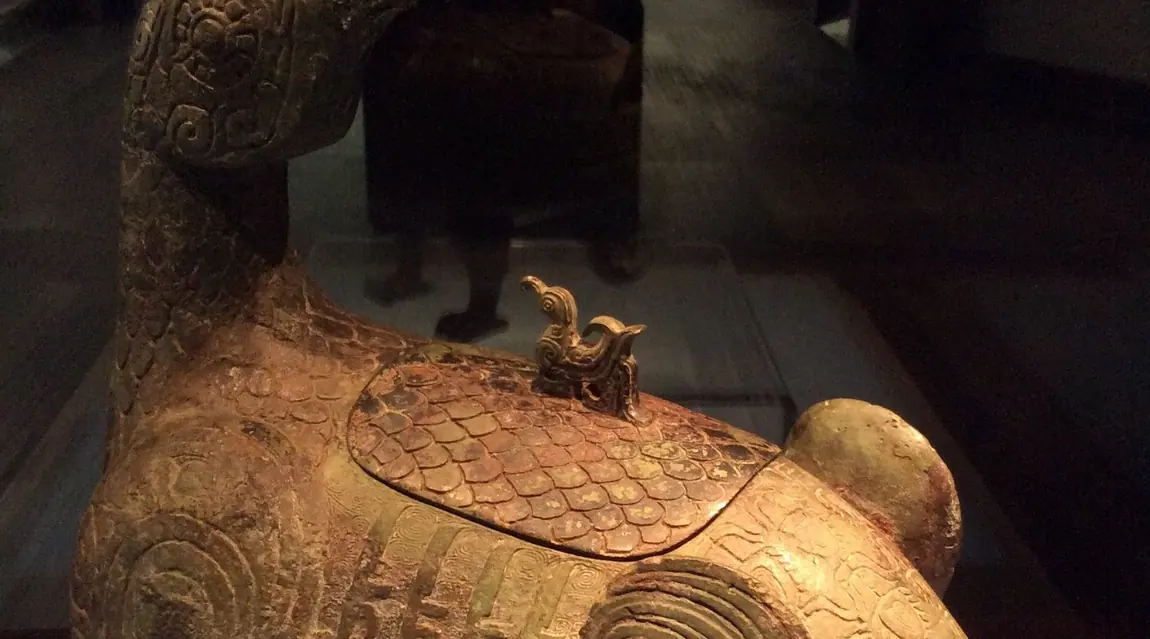
The bird-shaped zun sits alone in its case, a Western Zhou bronze the color of dark tea, its beak slightly open, its tail feathers flared into a pour spout. It is roughly 3,000 years old, and it looks like it was cast by someone who had watched real birds for a long time. Standing in front of it inside Shanxi Museum [shahn-SHEE baw-woo-YWEN] (山西博物院, the main museum of Shanxi, whose bronze vessels, tomb figures, Buddhist objects, murals, and merchant-history displays turn a vague sense of “old China” into something structurally legible), you stop thinking about the region as a place you have read about and start seeing it as a place that has already been explaining itself for millennia.
Shanxi [shahn-SHEE] (山西, the north China landlocked territory whose cultural identity runs from Bronze Age ritual power through Buddhist cave-carving to merchant finance — all still physically present) does not always announce itself clearly to newcomers. The museum, located in Taiyuan [tie-YWEN] (太原, Shanxi’s capital, a modern city built over layers of dynastic and wartime history), is where that changes fastest. With more than 650,000 objects organized under its Jin Soul (晋魂) [jìn hún] (the museum’s organizing concept, tracing Shanxi’s identity from Bronze Age statecraft through Buddhist culture to merchant modernity) display structure, the museum does not flatten Shanxi into a textbook summary. It shows how early power, ritual order, Buddhist image-making, and merchant culture all accumulated in one place. After that, every temple and carved cliff face you visit reads differently.
The Museum as Front Door, Not Detour
Shanxi is not always immediately legible to first-time Western travelers. Beijing explains itself through imperial scale. Xi’an explains itself through dynastic fame. Shanxi is richer and more layered, but also less blunt about it. A cave complex, a spring shrine, an old bank, and a timber pagoda can seem like separate categories until something teaches you how they belong to the same story. The museum does that work unusually well because it frames the place through continuity rather than through isolated highlights.
The institution itself carries weight. Its predecessor dates back to 1919, and the current building has become Shanxi’s main collecting, conservation, research, and display center. The experience is not random. You are not looking at a few disconnected star pieces. You are entering the place where Shanxi’s own historical self-description has been assembled most clearly.
The Bronze Galleries Explain Why Shanxi Was Never Peripheral
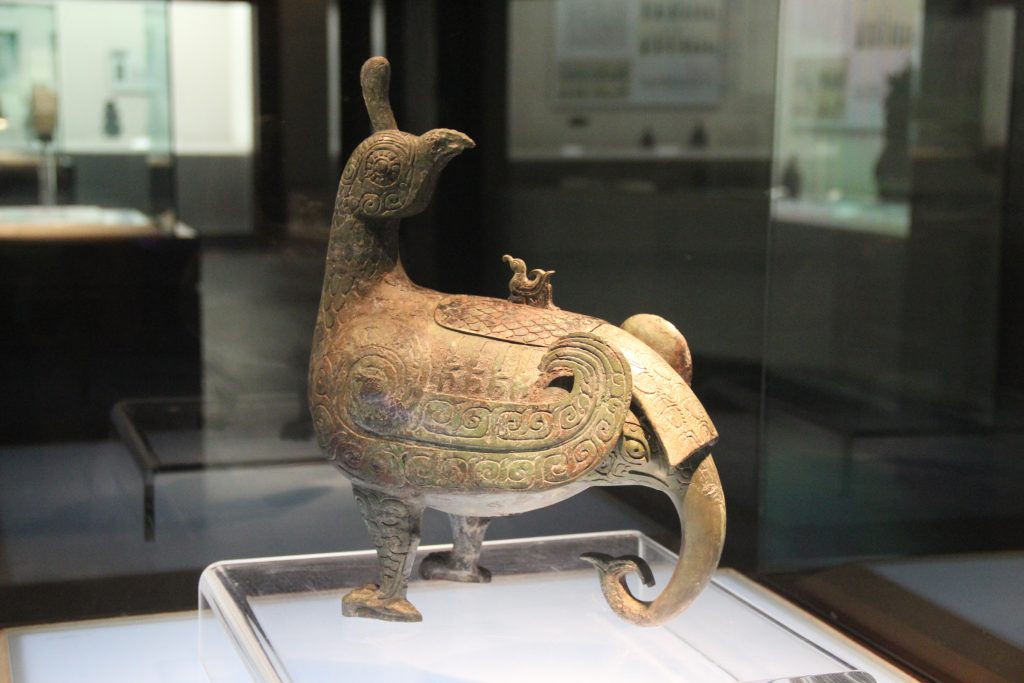
The strongest correction often begins with bronze. Once you start seeing the museum’s ritual vessels, bells, and courtly objects from the Jin state (晋国) [jìn guó] (the powerful Zhou-era kingdom that gave Shanxi its literary name and dominated the region for centuries) and earlier periods, Shanxi stops feeling like a secondary territory tucked behind better-known capitals. The bronzes tell a different story: this was a region of political gravity, elite ritual, and serious early power. Objects such as the bird-shaped zun — stocky, watchful, its surface crusted with green-black patina and geometric bands — do more than impress as beautiful things. They show that Shanxi sat inside the making of early Chinese order, not outside it.
That change in emphasis matters for travelers because many later Shanxi sites can otherwise look merely picturesque or “ancient.” Bronze pulls them backward into a deeper timeline. It says that when you enter later temples, compounds, and walled cities, you are not entering a forgotten backwater. You are entering a region that had already been politically and ritually serious for a very long time.
Clay, Sculpture, and Painted Surfaces Build the Northern Aesthetic
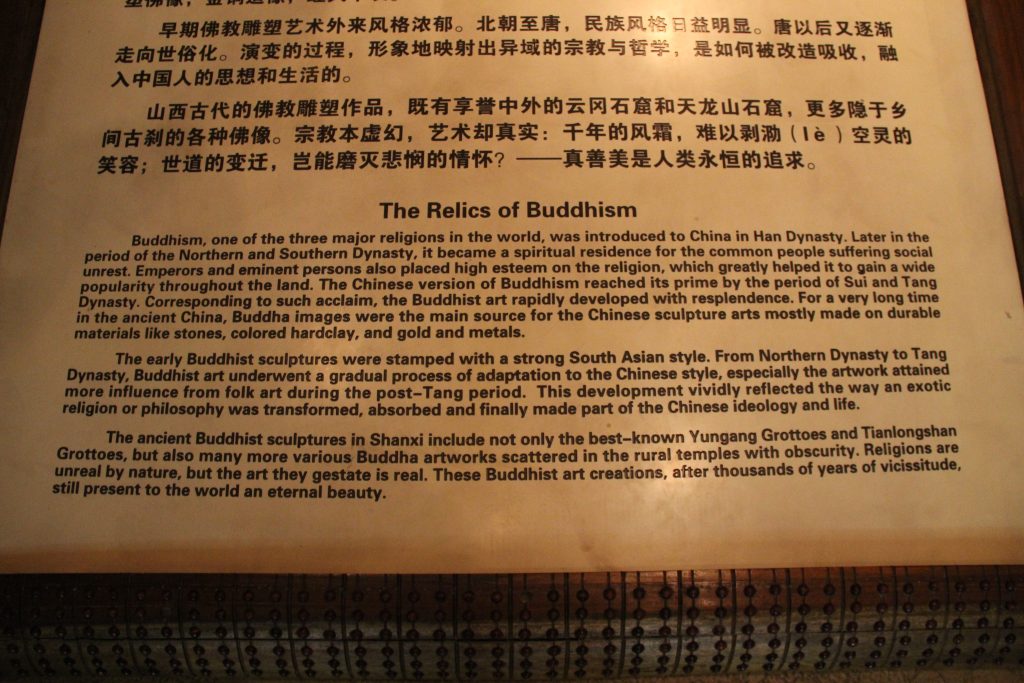
Then the museum changes register. Bronze explains power and ritual hierarchy. Clay figures, Buddhist sculpture, painted panels, and mural material explain how belief and northern visual culture took form. The gallery light drops lower here, warmer, and the painted sculptures seem to step forward out of their cases. A Tang-era clay attendant tilts her head at an angle that feels less like religious iconography and more like someone caught mid-thought. This is the point where Shanxi becomes more than a chronology. It begins to reveal a specific texture: carved faces with weight, religious images that feel inhabited rather than ornamental, a preference for form that is denser, quieter, and more structurally grounded than the glossy idea of “Chinese art” many visitors bring with them.
That matters because later outdoor sites depend on this visual preparation. When you eventually reach Datong [dah-TONG] (大同, Shanxi’s northern frontier city, shaped by centuries of steppe–empire contact) and stand before the Buddhist figures at Yungang Grottoes [YOON-gahng] (云冈石窟, the cave sanctuary where more than 50,000 Buddhist figures still hold the cliff face), or return to Taiyuan to see the Song clay attendants at Jinci Temple [JIN-tsuh] (晋祠, the spring shrine where architecture, sculpture, and landscape still work together), they no longer feel like disconnected marvels. The museum has already taught your eye what kinds of surface, posture, material, and belief-world to notice.
So Many Key Objects Never Left
Another useful lesson is simply that so much remains here. The museum’s holdings are not thin souvenirs of a lost region. They are dense because Shanxi itself is dense: major archaeological finds, long ritual history, Buddhist sculpture traditions, merchant wealth, mural painting, and regional collecting all fed the museum’s growth. That includes more than 40,000 precious cultural relics and some of the best-known bronzes, sculpture, and painted material in northern China.
For the traveler, the practical consequence is reassuring. The key evidence is still local enough to keep everything coherent. You do not have to imagine Shanxi through the fragments that were carried off elsewhere. You can still read early power, artistic confidence, and regional specificity right here, in the city where most trips begin. The museum makes that fact visible in a concentrated form.
After the Museum, the Province Sharpens
After a morning inside these galleries, Shanxi’s better-known sites stop competing with one another and start reinforcing one another. Yungang Grottoes becomes easier to read because the Buddhist and northern historical layers no longer feel abstract. Jinci Temple becomes richer because clay sculpture and ritual space already have context. Pingyao Ancient City [PING-yow] (平遥古城, the walled merchant city where late imperial finance still feels spatially legible) becomes more than a photogenic old town because the museum has already prepared you for the long relationship between hierarchy, exchange, and cultural continuity that defines this part of China.
Shanxi Museum is not where history gets locked behind glass. It is where the rest of the trip starts to glow from the inside. The landscape may still unfold outdoors — in cave shrines, timber halls, city walls, and merchant compounds. But for many travelers, the moment Shanxi first becomes clear happens indoors, among bronze and clay.
Worth noting: If you want the museum to anchor a wider Shanxi arc rather than float as a standalone Taiyuan stop, the itinerary that threads it forward through Datong, Pingyao Ancient City, frontier sites, and the Yellow River is Shanxi · Sacred Stone & Merchant Heritage – 10 Days 9 Nights.