

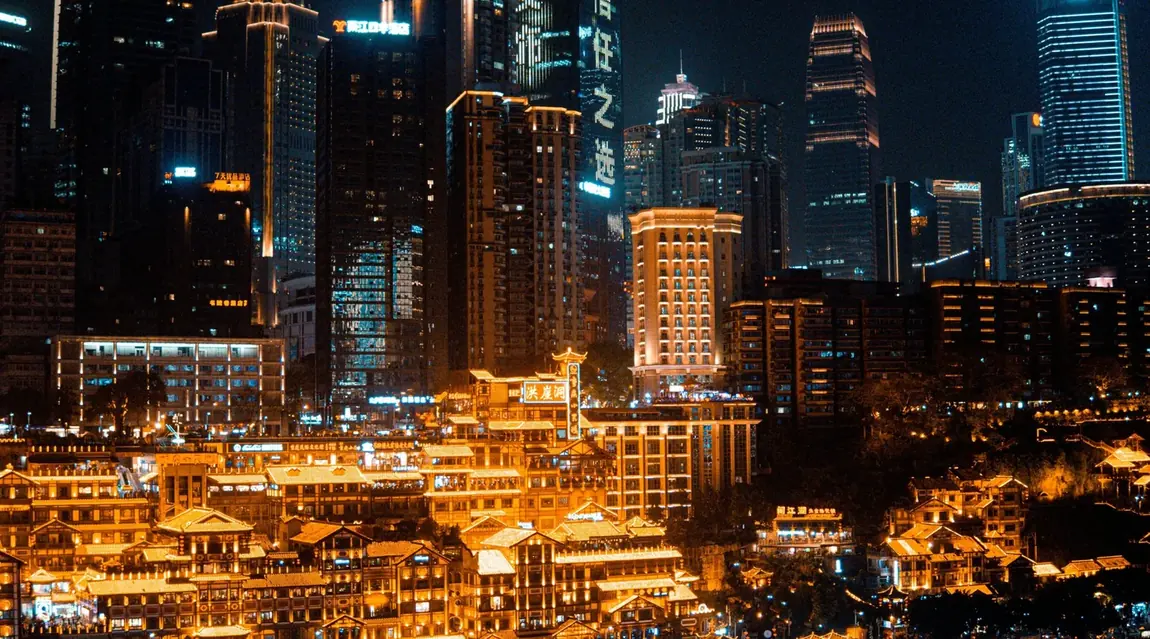
In Chongqing (China’s mountain megacity), few places spread faster across social media than Hongya Cave [hohng-YAH-dohng] (Hongyadong, a cliffside complex inspired by traditional stilt-house architecture). At night, the whole façade glows above the river in a way that barely looks real. The first reaction from many foreign travelers is simple: it looks like a fantasy set. The better reaction is more useful. Hongya Cave matters because it explains why Chongqing feels so visually different from other big Chinese cities in the first place.
For overseas visitors, the stop works best when you stop treating it as just another photo checkpoint. Hongya Cave is dramatic, yes, but it is also a readable shortcut into the city’s geography, architectural memory, and appetite for vertical life. The stacked façades recall diaojiaolou (traditional stilted houses built to adapt to steep, uneven terrain), while the crowds, food stalls, stairways, and river views remind you that this is still one of China’s most kinetic urban environments. It is not quiet, not delicate, and not meant to be consumed from one angle only.
Why It Feels So Specifically Chongqing
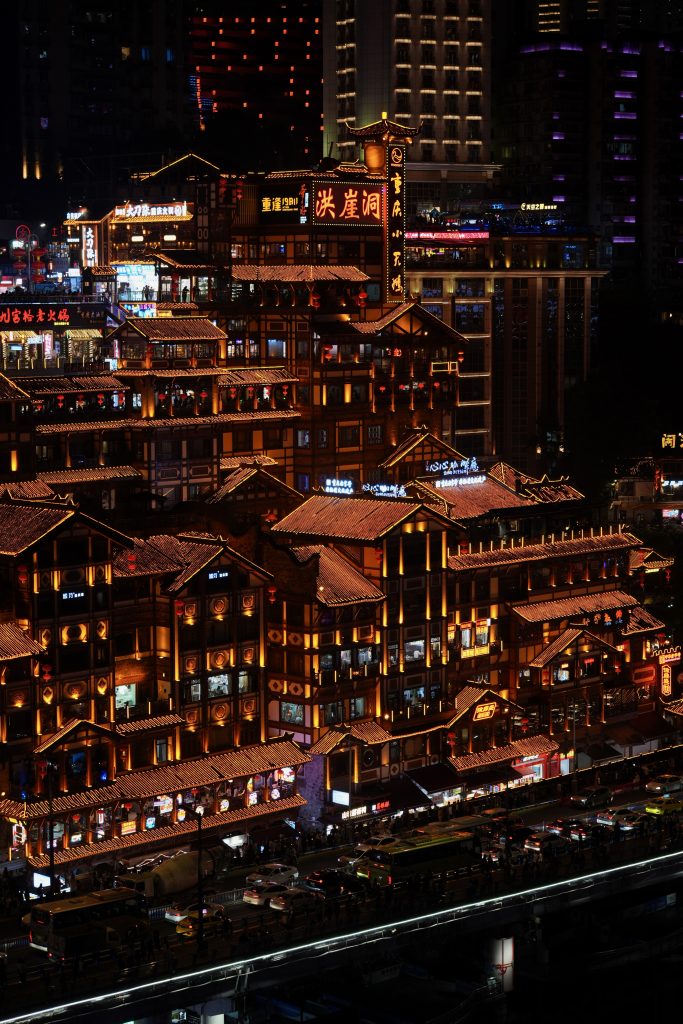
A lot of famous urban attractions could be copied into almost any city with enough money and lighting design. Hongya Cave would make less sense anywhere else. It sits above the Jialing River (the river that shapes central Chongqing’s northern edge) and reflects the logic of a city where streets rarely stay on one level for long. In Chongqing, walking often means climbing, descending, turning corners, finding another terrace, then realizing the “ground floor” on one side of a building is several levels away on the other. Hongya Cave translates that whole experience into one dense, instantly legible stop.
That is why the place photographs so well from a distance. You are seeing more than decorative lighting. You are seeing Chongqing’s relationship with slope, cliff, riverbank, and stacked circulation made visible. Put more simply: Hongya Cave looks vertical because Chongqing is vertical. The complex may be curated, but the drama behind it is real. When travelers say the city feels like it was built in layers, Hongya Cave is one of the clearest places to understand what they mean.
Not An Ancient Town, But Not An Empty Fake Either
This is where many first-time visitors get confused. Hongya Cave is not a preserved old quarter in the strict museum sense, and it is not the best stop if your only goal is untouched historical fabric. But dismissing it as fake misses the point too. What the site does well is stage a recognizable Chongqing architectural language for a contemporary audience. The layered timber look, overhanging forms, and cliffside composition are not random fantasy choices. They echo the older building logic associated with Bayu hillside life and riverbank settlement, even if what you are experiencing now is a modern commercial complex.
Hongya Cave is not valuable because it is frozen in the past. It is valuable because it makes Chongqing’s vertical imagination easy to see.
That distinction matters for Western readers because it sets the right expectation. If you arrive hoping for a silent archaeological zone, you may feel let down. If you arrive understanding that Hongya Cave is a stylized urban experience rooted in a real local form, it becomes much more interesting. Its success is not purity. Its success is legibility. In one stop, you get the cliff, the river, the lights, the crowded circulation, and the architectural vocabulary that helps explain why Chongqing so often feels closer to cinema than to a flat-grid metropolis.
How To Experience It Without Reducing It To A Photo Stop
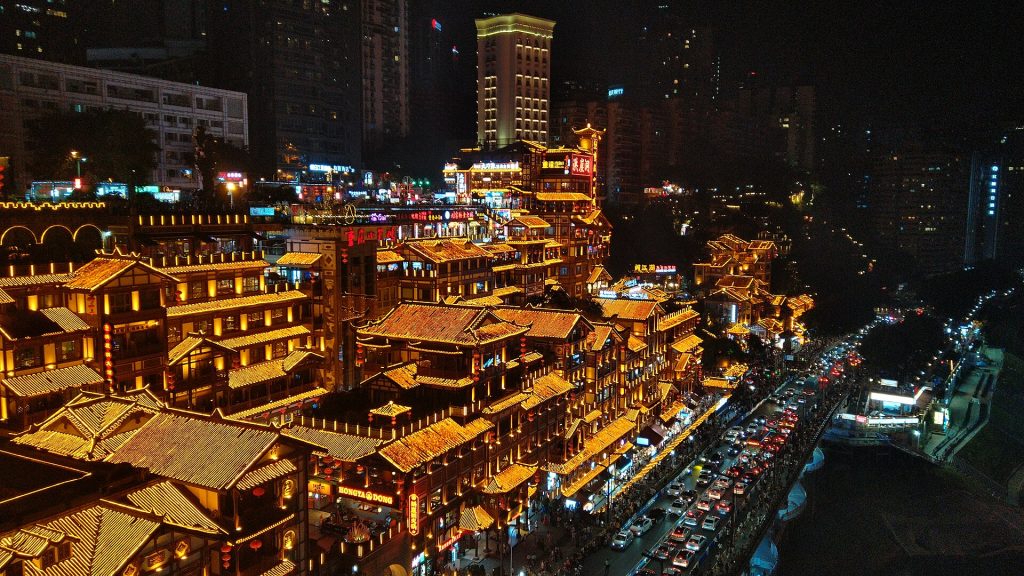
The easiest way to waste Hongya Cave is to arrive, take one front-facing night shot, then leave. The better approach is to treat it as a sequence rather than a single viewpoint. Come before sunset if you can. Watch the complex change as ambient light drops and the building begins to glow. Walk both the exterior edges and the interior levels. Step far enough away to see how the whole mass sits against the water, then come back in close to feel the density of stairs, terraces, snack stalls, and passing foot traffic.
- Arrive around dusk so you catch both the daytime structure and the nighttime lighting.
- See it from more than one level, because Chongqing rarely makes sense from only one level.
- Pair it with Qiansimen Bridge (the bridge spanning the Jialing River beside Hongya Cave) or a riverfront walk for the widest view.
- If you have time, connect it with Jiefangbei (central Chongqing’s main downtown core) so the visit feels like part of the city rather than an isolated spectacle.
You should also expect commerce. Hongya Cave is busy, photogenic, and unapologetically popular. Some travelers dislike that immediately. But popularity is part of the story here. Chongqing is a city that often feels loud, crowded, humid, and intensely alive. A polished but high-energy stop like this is not necessarily a betrayal of local character. In some ways, it mirrors the city better than a more polished heritage reconstruction would.
Why It Belongs On A First Chongqing Trip
For first-time visitors, the best attractions are not always the oldest or the most scholarly. Often, they are the ones that teach you how to read a place. Hongya Cave does that unusually well. It gives you a quick visual education in Chongqing’s relationship with topography, density, and spectacle. It also works as a bridge between different kinds of travelers: people who care about architecture, people who care about atmosphere, people chasing iconic night views, and people who simply want one stop that feels unmistakably tied to the city they came to see.
That is why Hongya Cave earns a place on smart itineraries even though it is easy to stereotype. Yes, it is famous. Yes, it is crowded. Yes, it is built for modern tourism as much as for local symbolism. But none of that cancels its value. If anything, the complex succeeds because it turns Chongqing’s real urban drama into a form visitors can immediately grasp. In a city that can feel disorienting in the best possible way, that is no small achievement.
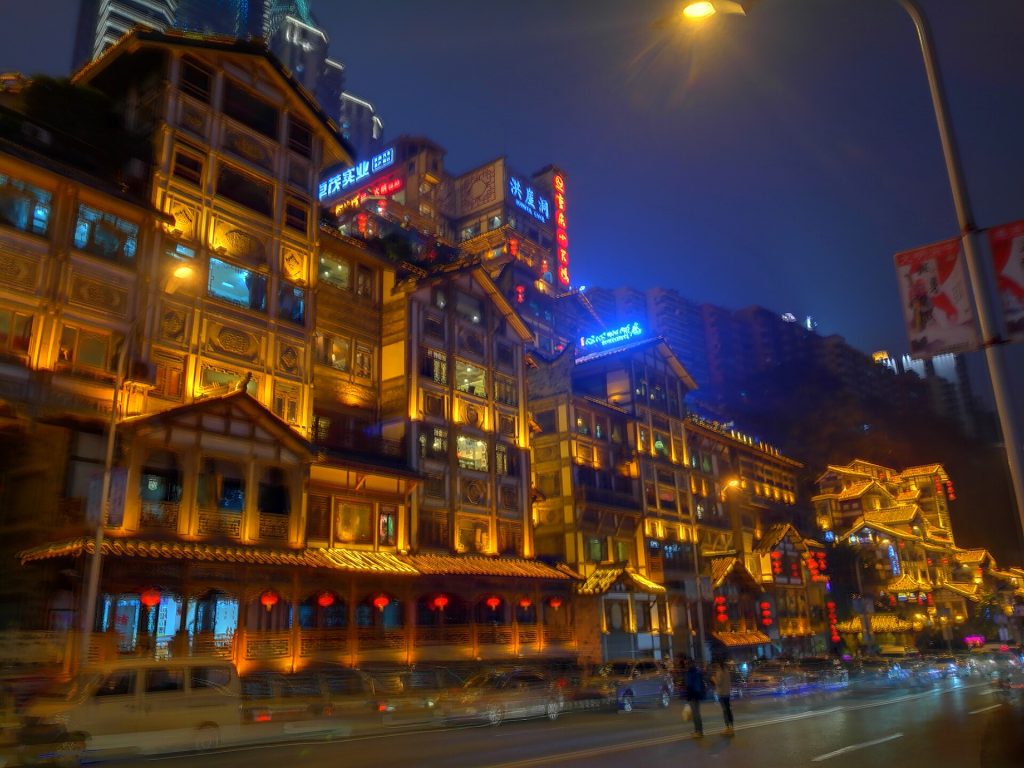
And that is the real travel value of Hongya Cave. Not that it proves Chongqing is pretty, because the city hardly needs help there. It matters because it condenses the city’s steepness, theatricality, and architectural memory into one experience that foreign travelers can actually decode. Go for the famous view if you want. Just do not stop there. The place becomes far more rewarding once you understand that the fantasy look is only the surface of a very real Chongqing story.
See it in context: Chongqing & Chengdu · Neon City & Sacred Mountain – 12 Days 11 Nights uses Hongya Cave as part of a wider Chongqing sequence, so the skyline drama reads as city logic rather than a standalone night-photo stop.
Image Credits
- Hongya Cave night lights — Lianguanlun / Wikimedia Commons (CC BY 4.0)
- Hongya Cave seen from Qiansimen Bridge — Jonashtand / Wikimedia Commons (CC BY-SA 4.0)
- Hongya Cave in Chongqing — Youyiy33 / Wikimedia Commons (CC BY-SA 4.0)